7 Patron Saints Every Catholic Should Know
Patron saints are heavenly intercessors who have been assigned by the Church or historical tradition to provide special protection and prayer for specific groups, places, or needs. These holy men and women are recognized as members of the Church Triumphant who stand before God and offer the prayers of the faithful on earth. Every Catholic should know the most influential patron saints, such as Saint Joseph and Saint Jude, to better utilize the spiritual resources of the Communion of Saints.
What Is a Patron Saint in the Catholic Church
A patron saint is a canonized member of the Church who has been chosen as a special advocate in heaven for a particular person, place, occupation, or circumstance. The Church teaches that these saints do not act by their own power, but rather through their proximity to the throne of God where they present our petitions. This practice is rooted in the doctrine of the Communion of Saints, which the Catechism of the Catholic Church defines as the spiritual solidarity of all members of the Church, whether living or deceased.
The historical origins of patronage date back to the early centuries of the Church when Christians would build churches over the tombs of martyrs. These martyrs were seen as the protectors of the local community. Over time, the list of popular patron saints grew to include confessors, virgins, and doctors of the Church who demonstrated specific virtues or faced particular trials. For instance, a saint who suffered from a specific illness often becomes the patron for those currently suffering from that same affliction.
When we refer to the intercession of saints, we are acknowledging that those in heaven remain concerned for their brothers and sisters on earth. This is not a distraction from the worship of God, but a fulfillment of the charity that binds the Body of Christ together. The Church officially recognizes thousands of saints, and many have been formally designated as patrons by the Holy See through the Dicastery for Divine Worship and the Discipline of the Sacraments. This formal process ensures that the devotion remains grounded in historical fact and sound theology.
The Difference Between Latria Dulia and Hyperdulia
The primary difference between these three terms lies in the nature and degree of honor being given to a person or to God. Latria is the supreme worship that is offered to God alone, including the Father, the Son, and the Holy Spirit. Catholics do not worship saints; rather, they offer dulia, which is the veneration or honor given to created beings who have achieved great holiness. To confuse these two is to commit the sin of idolatry, a distinction the Council of Trent made very clear in its twenty-fifth session.
Defining Hyperdulia for the Blessed Virgin Mary
Within the category of veneration, there is a special sub-category known as hyperdulia. This is the highest form of veneration, reserved exclusively for the Blessed Virgin Mary because of her unique role as the Mother of God. While hyperdulia is significantly greater than the dulia given to other saints, it remains infinitely less than the latria given to God. The Church maintains this hierarchy to ensure that Mary is honored as the most perfect creature without ever being equated with the Creator.
The Council of Trent (1545-1563) defended this practice against reformers who claimed that honoring saints detracted from the glory of Christ. The Council stated that it is "good and useful suppliantly to invoke them." By understanding the difference between worship and veneration, a Catholic can safely seek the help of the saints without violating the first commandment. This theological framework protects the unique sovereignty of God while celebrating the fruits of His grace in the lives of the elect.
| Term | Subject | Type of Honor | Necessity |
|---|---|---|---|
| Latria | The Holy Trinity | Adoration / Worship | Mandatory for all Christians |
| Hyperdulia | Virgin Mary | Highest Veneration | Recommended for all |
| Dulia | All other Saints | Veneration | Helpful for spiritual growth |
How the Church Designates Patron Saints
The Church designates patron saints through a combination of ancient tradition and formal ecclesiastical decrees. In the early Church, patronage was usually established by popular acclaim or local episcopal recognition. As the administrative structures of the Church became more centralized, the process of naming patrons for entire nations or specific modern professions became a matter for the Pope and the Roman Curia. Today, the Congregation for Divine Worship handles formal petitions for patronage, requiring a clear historical or theological link between the saint and the cause.
There are currently over 10,000 saints recognized by the Catholic Church, though not all have a specific patronage assigned to them. A saint might become a patron because of the manner of their death, a miracle performed during their life, or their professional career before entering the religious life. For example, Saint Matthew is the patron of accountants and tax collectors because he held that profession before being called by Christ. This connection allows the faithful to see their own lives reflected in the lives of the saints.
In addition to official designations, many Catholics choose personal patrons. This often happens during the Sacrament of Confirmation, where the candidate selects a name to signify a new spiritual identity. If you are preparing for this step, you can use the Catholic Bible to research the lives of holy men and women found in Scripture. By selecting a patron, the individual enters into a lifelong relationship of prayer and imitation with that saint. This is a practical application of the catholic patron saints list found in the Roman Martyrology, which serves as the official record of the Church's heroes.
Saint Joseph the Patron of the Universal Church
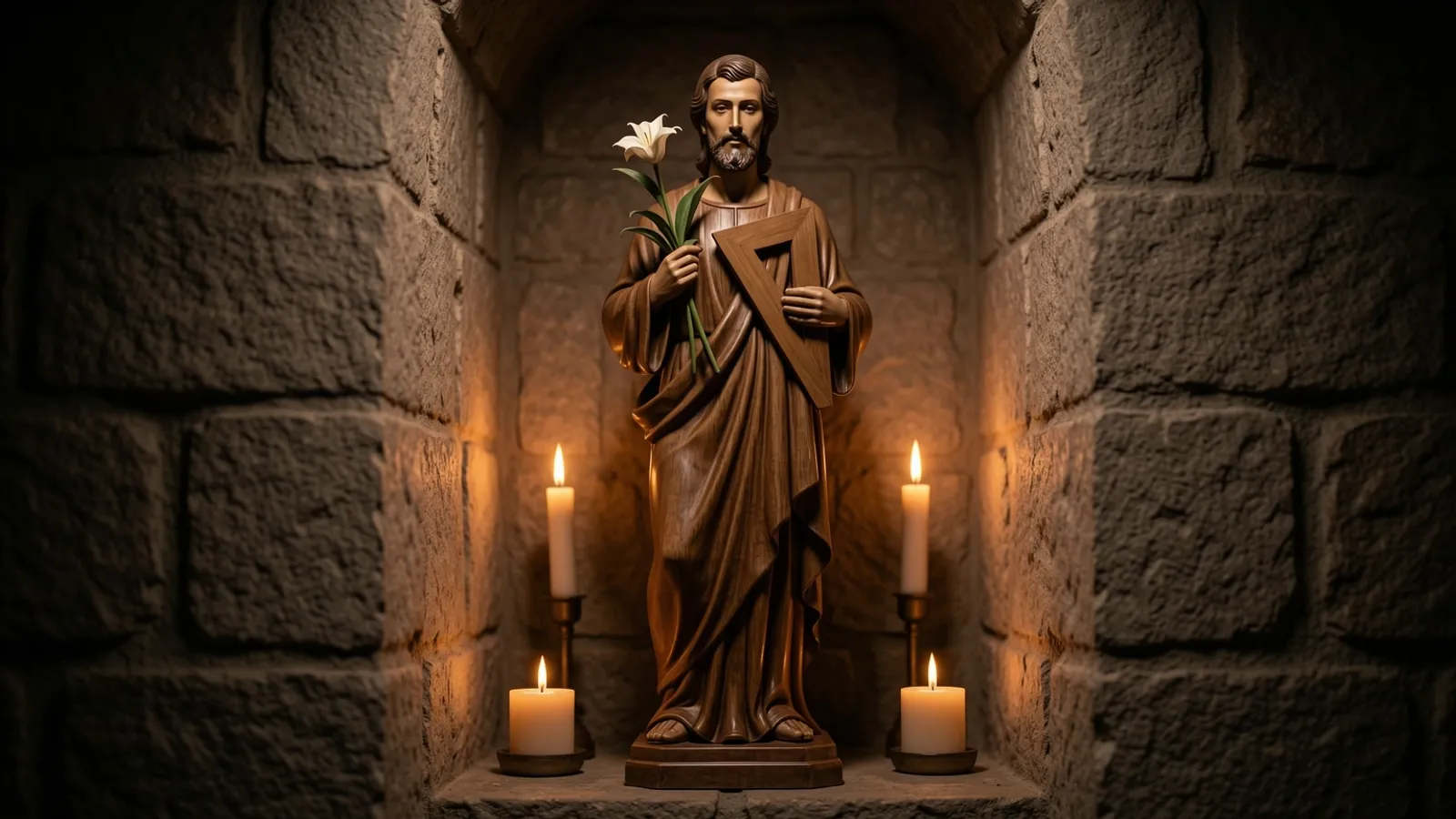
Saint Joseph is the most powerful intercessor after the Blessed Virgin Mary and serves as the patron of the universal Church. Pope Pius IX formally bestowed this title upon him on December 8, 1870, in the decree Quemadmodum Deus. As the foster-father of Jesus and the spouse of Mary, Joseph was the head of the Holy Family, and it is logically fitting that he continues to protect the Church, which is the mystical Body of Christ. He is also the patron of fathers, workers, and a happy death.
The Three Patronages of Saint Joseph
Saint Joseph's patronage is often categorized into three distinct areas of life. First, he is the patron of workers, a title emphasized by Pope Pius XII when he instituted the feast of Saint Joseph the Worker on May 1, 1955. This was intended to provide a Christian counterpoint to secular labor movements. Second, he is the patron of a happy death because tradition holds that he died in the arms of Jesus and Mary. Third, he is the protector of the family, providing a model of silent, humble service and obedience to the will of God.
Scripture describes Joseph as a "just man" in Matthew 1:19. He did not speak a single word recorded in the Gospels, yet his actions spoke of his total consecration to the mission of the Incarnation. Many saints, including Saint Teresa of Avila, have testified that while other saints may help in certain needs, Saint Joseph helps in all needs. He is a primary figure in any Catholic patron saints list due to his unique proximity to the Savior. Devotion to him often includes the Litany of Saint Joseph or the practice of the Seven Sundays.
He was chosen by the eternal Father as the trustworthy guardian and protector of his greatest treasures, namely, his divine Son and Mary, Joseph’s spouse. [Saint Bernardino of Siena]
Saint Jude Thaddeus the Patron of Hopeless Causes
Saint Jude Thaddeus is widely known as the patron of hopeless causes and desperate situations. He was one of the twelve Apostles and is often confused with Judas Iscariot, the betrayer. Because of this name similarity, many early Christians were hesitant to pray to him, fearing they might accidentally invoke the traitor. Consequently, Saint Jude became the "forgotten" Apostle. Tradition suggests that because he was only sought out when all other options failed, he became the specialist for the most difficult cases.
His popularity surged in the 19th and 20th centuries, particularly in the United States. Many hospitals and charitable institutions bear his name, testifying to the many miracles attributed to his intercession. When Catholics find themselves in financial ruin, terminal illness, or deep spiritual despair, they often turn to a Saint Jude Novena to ask for his help. The Church teaches that no situation is truly hopeless when placed in the hands of God, but Saint Jude serves as a reminder of God's power to act when human efforts are exhausted.
Saint Jude is typically depicted in art holding an image of Jesus, known as the Image of Edessa, and a club or axe, representing his martyrdom. He is also often shown with a tongue of fire above his head, signifying his presence at Pentecost. In his New Testament epistle, he encourages the faithful to "build yourselves up on your most holy faith" as seen in Jude 1:20. This call to perseverance is why he remains one of the most popular patron saints today. His feast day is celebrated on October 28.
Saint Anthony of Padua the Patron of Lost Things
Saint Anthony of Padua is perhaps the most frequently invoked saint in the daily life of Catholics, serving as the patron of lost things. Born in Lisbon, Portugal, in 1195, he eventually became a Franciscan friar and a brilliant preacher. The tradition of asking him to find lost items stems from an incident where a novice stole Anthony's book of psalms. Anthony prayed for its return, and the thief was moved by a terrifying vision to return the book and rejoin the order. This book is said to be preserved in the Franciscan friary in Bologna.
Beyond finding car keys or missing documents, Saint Anthony is a Doctor of the Church, a title granted in 1946 by Pope Pius XII. He is known as the "Hammer of Heretics" for his profound ability to explain the Catholic faith with such clarity that even those in error were converted. Catholics who are struggling with their faith or who have lost their way spiritually can learn how often Catholics should go to Confession and ask for Saint Anthony's guidance to find their path back to the state of grace. He reminds us that the most important thing to find is not a material object, but a right relationship with God.
Saint Anthony died at the young age of 36 and was canonized less than a year later, which is one of the fastest canonizations in Church history. His shrine in Padua attracts over 350,000 pilgrims annually, making it one of the most visited religious sites in Italy. He is usually depicted holding the Child Jesus and a lily, symbolizing his purity and his intimate connection to the Word made flesh. For those who want to honor him, the Litanies of the Church include beautiful prayers dedicated to his virtues.
Saint Therese of Lisieux the Patron of Missions
Saint Therese of Lisieux, also known as the "Little Flower," is the patron of missions and florists. This patronage is unique because Therese was a cloistered Carmelite nun who never left her convent in France during her religious life. However, her deep desire to save souls and her constant prayers for priests in the mission field led the Church to name her the co-patron of missions alongside Saint Francis Xavier in 1927. She proves that one does not need to travel to the ends of the earth to be a missionary; one only needs a heart on fire with love for God.
Therese is famous for her Little Way, a spiritual path of doing small, everyday actions with extraordinary love. She taught that we do not need to perform great heroic deeds to become saints; rather, we can offer up the smallest sacrifices, like a smile to a difficult person or the patient endurance of a cold, for the glory of God. This approach to holiness is documented in her autobiography, Story of a Soul, which has been translated into over 50 languages. In 1997, Pope John Paul II declared her a Doctor of the Church, making her the youngest person to receive that honor.
Her promise to "spend my heaven doing good on earth" and to let fall a "shower of roses" has led to countless reports of miracles and answered prayers. When Catholics ask for her intercession, they often look for a sign of a rose as an indication that their prayer has been heard. To understand the depth of her theology, one can look at how to pray the Rosary and reflect on the mysteries of Christ through the lens of her simple, childlike trust. She remains a primary example of how the intercession of saints works through humble, hidden lives.
Saint Michael the Archangel the Patron of the Sick and Police
Saint Michael the Archangel is the leader of the heavenly hosts and the patron of police officers, soldiers, and the sick. Unlike the other saints on this list, Michael is not a human being who lived on earth but an angelic spirit created by God. His name in Hebrew means "Who is like God?" which was his battle cry when he cast Lucifer out of heaven. The Church has long invoked him as the defender against the powers of darkness and the protector of the people of God.
In 1884, Pope Leo XIII composed the famous Prayer to Saint Michael after having a vision of the spiritual attacks that would face the Church in the 20th century. He mandated that this prayer be said after every Low Mass, a practice that many parishes have recently revived. Saint Michael is also considered the patron of the sick because he is one of the angels who brings the healing power of God to those in need. In the traditional Roman Liturgy, he is mentioned in the Confiteor and the prayers of the Offertory, highlighting his role as the one who presents the prayers of the faithful to God.
| Attribute | Description |
|---|---|
| Feast Day | September 29 (Michaelmas) |
| Weapon | A flaming sword or spear |
| Primary Role | Defender of the Faith and Prince of the Heavenly Host |
| Scripture | Revelation 12:7 |
Saint Michael's patronage of the police stems from his role as the enforcer of divine justice and the protector of the innocent. In a world often filled with conflict and danger, he serves as a spiritual guardian for those who put their lives on the line for the safety of others. He is often depicted in art treading upon a dragon or a serpent, representing his victory over the devil. This imagery is a powerful reminder of the ultimate triumph of good over evil. To learn more about his role in the life of the Church, one might study who was Saint Athanasius and how early Church fathers defended the divinity of Christ against the same spirits Michael defeated.
Saint Francis of Assisi the Patron of Animals and Ecology
Saint Francis of Assisi is perhaps one of the most beloved figures in Christian history, serving as the patron of animals, merchants, and ecology. Born into a wealthy merchant family in 1181, Francis abandoned his inheritance to live a life of radical poverty in imitation of Christ. He founded the Order of Friars Minor, commonly known as the Franciscans. His deep love for all of creation earned him the title of patron of ecology from Pope John Paul II in 1979.
Francis believed that all creatures were brothers and sisters because they all had the same Creator. Famous stories describe him preaching to birds and taming a wolf in the town of Gubbio. However, his love for nature was never a form of pantheism; it was always directed toward the worship of God. He is also the first recorded person to receive the stigmata, the physical wounds of Christ's passion, which appeared on his body in 1224. This profound union with the suffering of Jesus is the true source of his joy and his peace.
His feast day on October 4 is often marked by the blessing of animals at Catholic parishes. While he is a popular figure in secular culture, it is important to remember that his life was defined by the Cross. He famously created the first Nativity scene in Greccio to help people visualize the poverty of the Incarnation. To follow in his footsteps, a Catholic might study the Catholic fasting rules to practice the detachment from worldly goods that Francis championed. He remains a powerful intercessor for those who seek to live simply and care for God's creation.
Most High, all-powerful, good Lord, Yours are the praises, the glory, and the honor, and all blessing. [Saint Francis of Assisi, Canticle of the Sun]
Saint Monica the Patron of Difficult Marriages and Wayward Children
Saint Monica is the patron of difficult marriages and wayward children, known primarily for her persistent prayer for the conversion of her son, Saint Augustine. Born in North Africa in 332, she was married to a pagan official named Patricius, who was known for his violent temper. Through her patience and prayers, she eventually saw her husband and his mother convert to the faith before his death. Her life serves as a model for anyone struggling with familial discord or the spiritual wandering of loved ones.
For nearly 17 years, Monica followed her son Augustine across the Mediterranean, weeping and praying as he fell into various heresies and a life of sin. She consulted a bishop who famously told her, "the son of so many tears cannot perish." Her prayers were finally answered in 387 when Augustine was baptized by Saint Ambrose in Milan. Augustine went on to become one of the greatest Doctors of the Church, proving that a mother's intercession can change the course of history. Monica died shortly after his conversion, having fulfilled her life's mission.
Catholics today turn to Saint Monica when they feel the pain of a child leaving the Church or a marriage that seems beyond repair. She is a reminder that God’s timing is not our own and that perseverance in prayer is a form of spiritual warfare. Her feast day is August 27, followed immediately by the feast of Saint Augustine on August 28. By studying her life, we see the power of the intercession of saints in a very personal, domestic context. For those in similar situations, using the Novena Calculator to time a period of prayer for a loved one’s return to the faith is a practical way to follow her example.
Why Catholics Pray to Patron Saints for Intercession
The practice of praying to patron saints is based on the biblical understanding that the prayers of the righteous are effective. In James 5:16, we are told that "the prayer of a righteous man has great power in its effects." If the prayers of holy people on earth are powerful, how much more powerful must be the prayers of those who are already in heaven and perfectly united to God? We do not pray to saints as if they were the source of grace, but as friends who can help us obtain grace from the one true Source.
This concept is further supported by the Book of Revelation, which depicts the saints in heaven offering the prayers of the faithful on earth to God. Revelation 5:8 describes the elders in heaven holding "golden bowls full of incense, which are the prayers of the saints." This heavenly liturgy shows that the transition from this life to the next does not end our relationship with the Church, but rather perfects it. We ask saints for their intercession in the same way we might ask a friend on earth to pray for us, only the saint has a more direct "line" to the Lord.
Furthermore, the saints provide us with models of how to live the Gospel in diverse circumstances. By studying a catholic patron saints list, we see that holiness is possible for everyone, regardless of their profession or state in life. Whether you are a parent, a soldier, a student, or a suffering person, there is a saint who has walked that path before you. Prayla offers a comprehensive Prayer Library where you can find specific devotions to these heavenly patrons, helping you to integrate their wisdom into your daily spiritual life.
Common Misconceptions About Patron Saints
One of the most frequent misconceptions held by non-Catholics is the idea that praying to saints is a form of necromancy or communicating with the dead. However, the Church teaches that those in heaven are more alive than we are, as they share in the eternal life of God. In Matthew 22:32, Jesus says, "He is not God of the dead, but of the living." Therefore, asking for the intercession of a saint is an act of faith in the Resurrection and the victory of Christ over death.
Another common objection is that having patron saints for specific needs is a remnant of paganism, where different gods were responsible for different areas of life. The difference between the pagan view and the Catholic view is the source of power. In paganism, the gods acted independently. In Catholicism, the saint has no power of their own; all their influence comes from the grace of Jesus Christ. The use of patrons is simply a way of organizing the vast family of God and recognizing that God delights in using His creatures to help one another.
Some also worry that devotion to saints distracts from the unique mediatorship of Christ. The Catechism of the Catholic Church addresses this by stating that Christ's mediatorship does not exclude, but rather gives rise to, a manifold cooperation which is but a sharing in this one source (CCC 970). Just as a teacher is not offended when a student helps another student, Christ is not offended when His saints help their brothers and sisters on earth. In fact, it glorifies Him to see the fruits of His redemption active in the lives of His followers. To deepen your understanding of this, you might read about what the Bible says about the Eucharist to see how the entire Church is united in one sacrificial act.
How to Find Your Personal Patron Saint
Finding a personal patron saint is a beautiful way to deepen your spiritual life and feel more connected to the heavenly community. The most traditional way to find a patron is to look at your Name Saint. This is the saint whose name you were given at Baptism. If you were named after a saint, that holy person has been your protector since you entered the Church. You can research the feast day of your namesake and celebrate it as a second birthday, thanking God for the life of that saint.
Another method is to look at your profession or your specific struggles. The Church has designated patrons for almost every occupation imaginable. For example, Saint Mark the Evangelist is the patron of lawyers and prisoners, while Saint Luke is the patron of doctors. If you are struggling with a specific sin, you can find a saint who overcame that same vice. For instance, those struggling with intellectual pride might look to when is the feast of Saint Catherine of Siena 2026 to honor a woman who was both a mystic and a profound theological influence.
You can also find a patron by "letting the saint find you." This often happens through a recurring encounter with a saint’s name, an icon, or a story that resonates deeply with your soul. Some people use a "Saint of the Year" generator or draw a name from a hat on Epiphany. Once you have identified a saint, begin to read their writings or biographies. If you are ever unsure of where to start, the Catholic Saints section of the Prayla app provides a wealth of information on the lives and patronage of thousands of holy men and women.
Practical Guide to Developing a Devotion to the Saints
Developing a devotion to a patron saint is a gradual process that involves both the mind and the heart. It is not about superstitious rituals, but about building a real relationship with a member of your spiritual family. Like any relationship, it requires time, communication, and imitation. By following a structured approach, you can ensure that your devotion remains balanced and leads you closer to Christ.
Building a Domestic Oratory
A domestic oratory, or a simple prayer corner, is a dedicated space in your home for prayer. You can place an icon or a statue of your patron saint in this area. This serves as a visual reminder of their presence and their intercession. Lighting a candle before the image on their feast day or during times of special need is a traditional way to show honor. This practice helps to sanctify your home and creates a focused environment for your daily Catholic prayers.
To help you organize your devotion, consider these three levels of commitment:
- Beginner Level: Learn the basic facts of the saint's life. Memorize a short prayer for their intercession, such as "Saint [Name], pray for us." Acknowledge their feast day by attending Mass if possible.
- Intermediate Level: Read a full biography or the primary writings of the saint (if they exist). Pray a Novena to them for a specific intention once or twice a year. Try to imitate one specific virtue they practiced, such as patience or charity.
- Advanced Level: Perform a formal act of consecration if appropriate (such as to Saint Joseph). Share the story of your patron with others to spread their devotion. Support a charity or cause that is related to their patronage, such as supporting missions in honor of Saint Therese.
List of Patron Saints for Common Professions
- Accountants: St. Matthew
- Actors: St. Genesius
- Artists: St. Luke or Blessed Fra Angelico
- Bakers: St. Honoratus
- Carpenters: St. Joseph
- Cooks: St. Lawrence
- Doctors: St. Luke or St. Pantaleon
- Engineers: St. Ferdinand III
- Farmers: St. Isidore the Farmer
- Firefighters: St. Florian
- Lawyers: St. Thomas More or St. Ivo
- Musicians: St. Cecilia
- Nurses: St. Agatha or St. Camillus de Lellis
- Police Officers: St. Michael the Archangel
- Scientists: St. Albert the Great
- Social Workers: St. Louise de Marillac
- Students: St. Thomas Aquinas or St. Joseph of Cupertino
- Teachers: St. John Baptist de la Salle
- Writers: St. Francis de Sales
As you grow in your devotion, you may find that your patron saint becomes a constant companion in your spiritual journey. They offer encouragement when you are weary and correction when you stray. Always remember that the goal of every saint is to lead you more deeply into the heart of Jesus. If you find yourself struggling with a particular sin or habit, you might also find it helpful to read about what is mortal sin example and ask for your patron's help in maintaining a life of virtue.
Prayer
O God, who in Your unspeakable Providence were pleased to choose blessed Joseph for Your most holy Mother's spouse, grant, we beseech You, that we may deserve to have him for our intercessor in heaven, whom on earth we venerate as our holy protector. Who lives and reigns world without end. Amen.
Further Reading
- Catechism of the Catholic Church, Paragraphs 946-962 (The Communion of Saints)
- Pope Pius IX, Decree Quemadmodum Deus (Saint Joseph as Patron of the Universal Church)
- Pope John Paul II, Apostolic Exhortation Redemptoris Custos (On the Person and Mission of Saint Joseph)
- Council of Trent, Session XXV, Decree on the Invocation, Veneration, and Relics of Saints, and on Sacred Images
- Pope Pius XII, Encyclical Doctor Mellifluus (On Saint Bernard of Clairvaux and the Veneration of Saints)