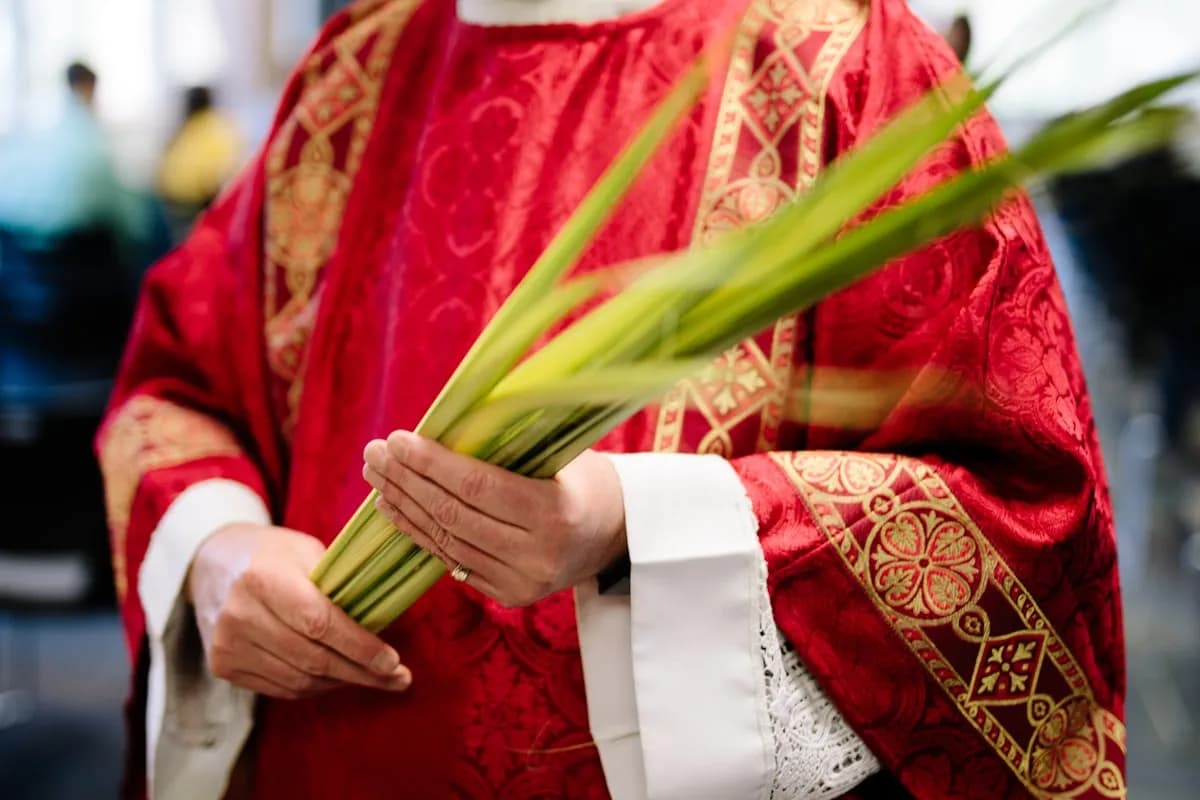
Palm Sunday
March 21The Lord's Entry into Jerusalem
The week opens with a dramatic shift in tone. Mass begins with a joyful procession — blessed palms, singing, the whole parish moving together to welcome Christ as king. Then the mood turns. The Passion narrative is read in full, usually with the congregation taking the part of the crowd. You hear your own voice shout "Crucify him!" and the weight of the week ahead starts to settle in.
Traditions & Practices
- Palms are blessed and distributed before Mass; many families tuck them behind a crucifix at home.
- The Passion Gospel is read or chanted in parts — the longest Gospel reading of the year.
- Red vestments are worn, symbolizing Christ's coming sacrifice.
At home: Bring your blessed palms home. Place them behind a cross or sacred image. Some families begin reading one chapter of the Passion each evening this week.
Monday of Holy Week
March 22Jesus Anointed at Bethany
The Gospel tells of Mary of Bethany anointing Jesus' feet with costly perfumed oil — a beautiful, extravagant act of love that Judas criticizes as wasteful. Jesus defends her: "You always have the poor with you, but you do not always have me." The readings this week progressively build toward the Passion, drawing from the Suffering Servant passages of Isaiah.
Traditions & Practices
- Many parishes offer additional confession times throughout this week.
- The Chrism Mass may be celebrated in the diocese (sometimes moved to Tuesday or Wednesday).
At home: A good day to go to confession if you haven't yet this Lent. The lines will be shorter than Thursday or Saturday.
Tuesday of Holy Week
March 23Jesus Foretells His Betrayal
Jesus tells the apostles plainly: "One of you will betray me." The passage ends with Judas leaving the table and stepping into the night. John adds an unforgettable detail: "And it was night." Meanwhile, Peter boldly promises to lay down his life — and Jesus tells him he'll deny him three times before the cock crows.
Traditions & Practices
- In many dioceses, the bishop celebrates the Chrism Mass on this day, blessing the sacred oils used in sacraments throughout the year.
At home: Reflect on the ways you have been Judas and the ways you have been Peter. Both betrayed Christ. Only one turned back.
Wednesday of Holy Week
March 24Spy Wednesday
Known traditionally as Spy Wednesday, this is the day Judas approached the chief priests and agreed to hand Jesus over for thirty pieces of silver. The price of a slave. The Gospel's tone is chilling in its matter-of-factness: "From that time on he looked for an opportunity to hand him over."
Traditions & Practices
- The Tenebrae service ("Shadows") is sometimes celebrated Wednesday evening, with candles extinguished one by one as psalms are chanted.
- This is the last day of ordinary Lent; the Sacred Triduum begins tomorrow evening.
At home: Prepare for the Triduum. Clear your schedule for the next three days if you can. These are the most sacred days of the entire year.
Holy Thursday
March 25Mass of the Lord's Supper
The Triduum begins. The evening Mass commemorates three events: the institution of the Eucharist, the institution of the priesthood, and Christ's commandment to love through service, shown when he washed the apostles' feet. The Gloria is sung for the first time since Lent began, the bells ring out — and then fall silent until the Easter Vigil. After Mass, the Blessed Sacrament is carried in procession to an altar of repose, and the faithful are invited to keep watch.
Traditions & Practices
- The priest washes the feet of parishioners during Mass, echoing Christ's act of service.
- After Mass, the altar is stripped bare and the tabernacle left open and empty — a powerful visual of what is coming.
- Adoration at the altar of repose continues late into the night. "Could you not watch one hour with me?"
At home: If you cannot attend adoration, spend an hour in quiet prayer at home. Some families wash each other's feet after dinner.
Good Friday
March 26The Passion of the Lord
The only day of the year when Mass is not celebrated anywhere in the Latin Rite. The church is bare, the tabernacle empty. The afternoon liturgy has three parts: the Liturgy of the Word (including the full Passion according to John), the Solemn Intercessions (ancient prayers for the whole world), and the Veneration of the Cross. The faithful approach the cross, one by one, to kiss or touch it.
Traditions & Practices
- Fasting and abstinence are required: one full meal, two smaller meals, no meat. Catholics ages 18–59 must fast; those 14 and older must abstain.
- The Stations of the Cross are prayed, often at 3:00 PM — the traditional hour of Christ's death.
- Churches remain bare, without flowers or decoration.
- The Solemn Intercessions are among the oldest prayers in the Roman liturgy, dating to at least the 5th century.
At home: Keep silence between noon and 3:00 PM if possible. Pray the Stations. Fast seriously — not as diet, but as a way of standing with Christ in his suffering.
Holy Saturday
March 27At the Lord's Tomb
The quietest day in the Church's year. There is no Mass, no sacraments except for Anointing of the Sick and Viaticum. Christ lies in the tomb. The ancient tradition holds that on this day, Christ descended to the dead and brought salvation to the righteous who had died before him — the "Harrowing of Hell." The church waits in silence.
Readings
No Mass readings during the day
Traditions & Practices
- No Mass is celebrated during the day. The church remains stripped and bare.
- Easter food baskets may be blessed in the afternoon (a strong tradition in Polish, Slovak, and other Central European communities).
- RCIA candidates spend the day in prayer and reflection before their baptism.
At home: This is a day for quiet. Resist the urge to jump ahead to Easter. Sit with the silence. Prepare Easter food. Prepare your heart.
The Easter Vigil
Saturday evening, March 27The Mother of All Vigils
The most important liturgy of the entire year. It begins in total darkness outside the church, where the Paschal candle is lit from a new fire. The light spreads from person to person until the whole church is glowing. Up to seven Old Testament readings trace salvation history from creation through the Exodus. Then the Gloria explodes back to life, bells ring, the organ sounds, and the Alleluia — unheard since before Lent — is finally sung again. Catechumens are baptized, confirmed, and receive their first Eucharist.
Traditions & Practices
- The Service of Light: the Paschal candle is lit and carried into the dark church as the deacon sings "Lumen Christi" (Light of Christ).
- The Exsultet is chanted — a soaring, ancient hymn of praise that is one of the great treasures of Catholic liturgy.
- RCIA catechumens and candidates are received into full communion with the Church.
- Holy water is blessed and used to renew baptismal promises for the entire congregation.
At home: Bring home the light: some parishes give small candles to take home from the Vigil. Easter begins tonight, not tomorrow morning.