History of the Divine Mercy Devotion
The ultimate answer to what is the meaning of life is to know, love, and serve God in this world and to be happy with Him forever in the next. The Catholic Church teaches that this purpose is fulfilled through the reception of God's grace, specifically through the divine mercy history revealed to the world in the twentieth century. This devotion provides a clear path for the soul to return to its Creator by trusting in His infinite goodness and participating in the sacramental life of the Church.
What Is the Historical Context of the Divine Mercy Message
The historical context of the Divine Mercy message is rooted in the period between the two World Wars, a time of profound spiritual and political upheaval in Europe. During the 1930s in Poland, the world was facing the rise of totalitarian ideologies, such as Communism and National Socialism, which sought to strip human life of its inherent dignity. In this dark era, the catholic devotion history took a significant turn when a simple religious sister began receiving private revelations that would eventually reach the universal Church. The Magisterium holds that God often provides specific remedies for the particular spiritual illnesses of an age, and Divine Mercy was the remedy for a world drifting toward despair and self-destruction.
The message was not a new doctrine but a modern emphasis on the perennial truth of the Gospel. As the Catechism of the Catholic Church states, God's mercy is His greatest attribute, manifested most clearly in the Paschal Mystery of Christ. In the years leading up to World War II, the spiritual climate was one of legalism on one hand and growing atheism on the other. Many souls felt that their sins were too great for God to forgive, or they had lost the sense of sin altogether. The origin of divine mercy chaplet and the associated revelations served to remind the faithful that no sin is greater than God's capacity to forgive, provided the soul turns to Him with trust.
By 1931, the year of the first major apparition, the world was still reeling from the Great Depression. The socio-economic instability mirrored the spiritual poverty of the masses. In this environment, the meaning of life was often reduced to material survival or political loyalty. The revelations given to Saint Faustina reoriented the focus toward the eternal destiny of the soul. This period in divine mercy history demonstrates how the Church remains a beacon of hope even when secular foundations crumble. Through these revelations, Christ called for a return to the basics of faith: trust in God and mercy toward one's neighbor.
Who Was Saint Faustina Kowalska
Saint Faustina Kowalska, born Helena Kowalska in 1905 in Glogowiec, Poland, was the chosen instrument for the Divine Mercy revelations. She was the third of ten children in a poor, devout peasant family and received only three winters of formal schooling. Despite her lack of education, her spiritual life was exceptionally deep from a young age. At the age of seven, she first felt a calling to the religious life while attending Vespers. After several years of working as a domestic servant to help support her family, she entered the Congregation of the Sisters of Our Lady of Mercy in Warsaw in 1925, taking the name Sister Maria Faustina of the Blessed Sacrament.
The Sisters of Our Lady of Mercy
This religious community was dedicated to the care and education of troubled young women, known as "Magdalenes." Sister Faustina lived a hidden life, performing humble tasks such as cooking, gardening, and serving as a porter. Most of her fellow sisters had no idea of the extraordinary mystical experiences she was undergoing. The st faustina divine mercy story is characterized by this profound humility; she did not seek fame or recognition, but rather sought to be a "victim soul" for the sake of sinners. Her diary, which she kept at the command of her spiritual director, records her interior conversations with Jesus Christ and remains a primary text for understanding this devotion.
Faustina's life was marked by physical suffering as well as spiritual trials. She contracted tuberculosis, which eventually led to her death at the young age of 33 in 1938. During her final years, she spent much time in the infirmary, where she continued to record the messages she received. The Church canonized her as the first saint of the new millennium on April 30, 2000. Her life serves as a testament that God chooses the weak and humble to shame the strong, as described in 1 Corinthians 1:27. For those seeking to deepen their own spiritual walk, learning about 7 patron saints every Catholic should know can provide further inspiration from the lives of the holy.
What Happened During the First Apparition in Plock
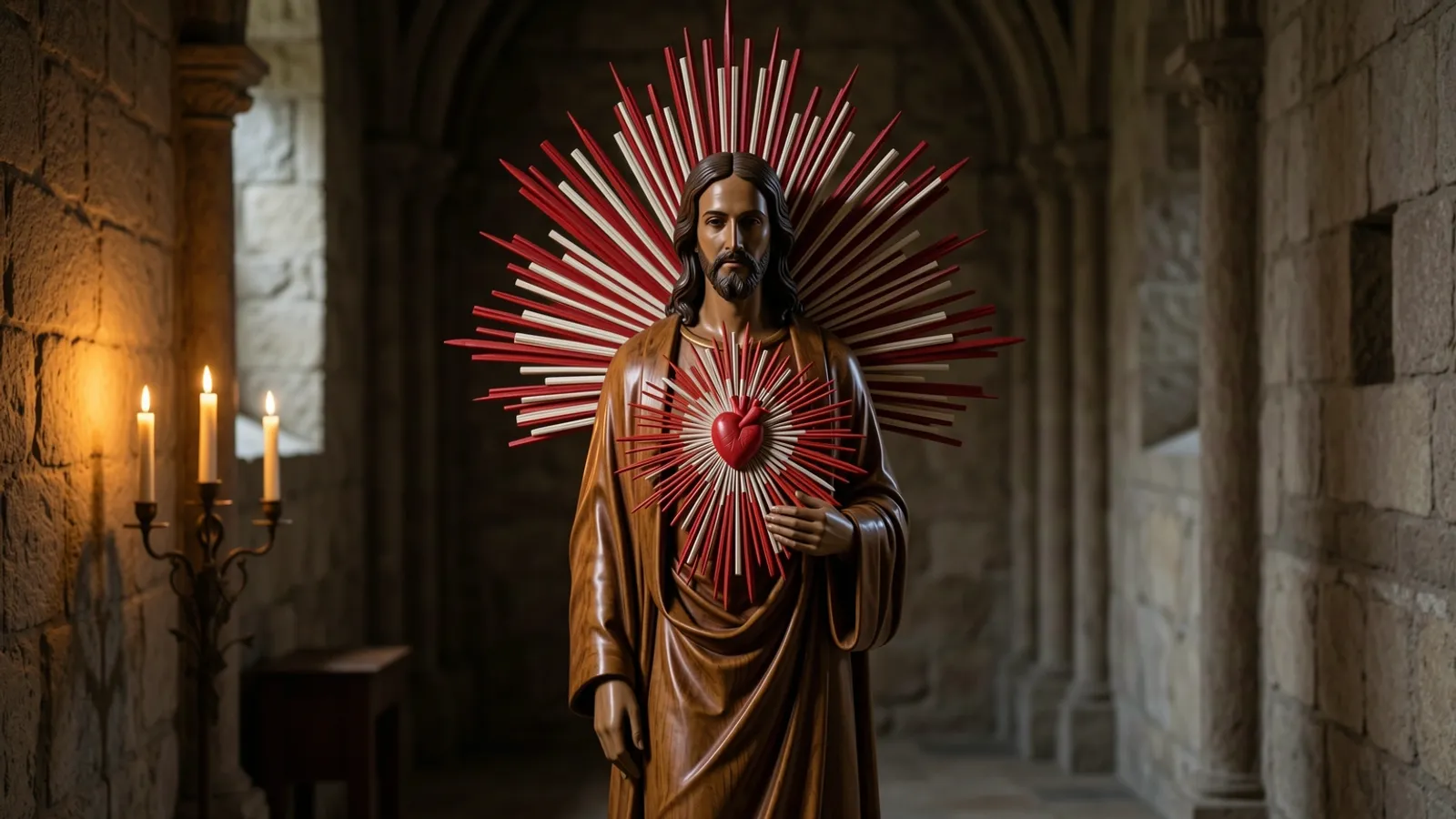
The first major apparition of the Divine Mercy occurred on the evening of February 22, 1931, in the convent in Plock, Poland. Sister Faustina was in her cell when she saw Jesus clothed in a white garment. His right hand was raised in a gesture of blessing, while His left hand was touching His garment at the breast. From the opening of the garment at the breast, two large rays came forth, one red and the other pale. Jesus told her to paint an image according to the pattern she saw, with the signature: Jesus, I trust in You. This event is the cornerstone of the origin of divine mercy chaplet and the wider devotion.
Jesus explained the meaning of the rays during later revelations. The pale ray represents the Water which makes souls righteous, and the red ray represents the Blood which is the life of souls. This imagery directly references the piercing of Christ's side on the Cross, as recorded in John 19:34. The catholic devotion history emphasizes that these rays represent the sacraments of Baptism and the Eucharist, as well as the gift of the Holy Spirit. Christ promised that the soul that venerates this image will not perish and will have victory over its enemies already here on earth, especially at the hour of death.
Initially, Faustina struggled with the command to paint the image, as she was not an artist. She attempted to find someone to help her, but it was not until she was transferred to Vilnius that she found the necessary support. The st faustina divine mercy narrative shows that God's commands often require human cooperation and perseverance. Faustina's obedience to this vision, despite her own limitations, allowed the divine mercy history to unfold as Christ intended. This apparition set the stage for the five main forms of the devotion: the Image, the Feast, the Chaplet, the Hour, and the spreading of the devotion.
How Did Blessed Michael Sopocko Assist the Devotion
Blessed Michael Sopocko was the spiritual director of Saint Faustina during her time in Vilnius from 1933 to 1936. He played an indispensable role in the history of the divine mercy devotion by providing the theological grounding and practical assistance needed to fulfill Christ's requests. When Faustina first told him of her visions, he was skeptical and even requested that she undergo a psychiatric evaluation. Once her mental health was confirmed, he began to take her revelations seriously and guided her in discerning the voice of God from her own imagination.
The First Painting by Eugeniusz Kazimirowski
Father Sopocko commissioned the artist Eugeniusz Kazimirowski to paint the Divine Mercy image in 1934. He personally supervised the work, ensuring that every detail matched Faustina's descriptions. Faustina wept when she saw the finished painting, complaining that it was not as beautiful as the Jesus she saw in her visions, but Jesus reassured her that the value of the image lay not in the art, but in His grace. Sopocko was also responsible for the first public veneration of the image, which took place during the triduum marking the close of the Jubilee Year of Redemption in April 1935.
Beyond the image, Father Sopocko worked tirelessly to promote the theological basis for a Feast of Divine Mercy. He wrote numerous books and articles explaining that mercy is the greatest attribute of God. His efforts were crucial because Faustina herself was a cloistered nun with limited reach. Without his intervention, the origin of divine mercy chaplet might have remained a local or private phenomenon. He continued to promote the devotion for decades after Faustina's death, even during the years when it was suppressed by the Vatican. His persistence is a model for how the clergy and laity must work together to spread the Catholic Bible teachings and the traditions of the Church.
What Is the Origin of the Divine Mercy Chaplet
The origin of the Divine Mercy Chaplet dates back to a series of visions Faustina received on September 13 and 14, 1935. In these visions, she saw an angel sent by God to chastise the earth. She began to pray for mercy, but her words were powerless until she heard an interior voice teaching her a new prayer. This prayer, which she called the Chaplet, was offered to appease God's anger for the sins of the world. The next day, Jesus instructed her on how to pray it using a standard set of rosary beads.
The Visions of the Angel of Wrath
During the vision, Faustina saw the "Angel of Wrath" about to strike a city. She pleaded for mercy, citing the merits of Christ's Passion. The Chaplet's core prayer, "Eternal Father, I offer You the Body and Blood, Soul and Divinity of Your Dearly Beloved Son, Our Lord, Jesus Christ, in atonement for our sins and those of the whole world"—is a deeply Eucharistic petition. It echoes the language used by the Council of Trent regarding the Real Presence and the propitiatory nature of the Mass. You can learn how to pray the Divine Mercy Chaplet to participate in this powerful intercession.
The Chaplet is intended to be a communal and individual prayer for mercy. Jesus promised that those who pray it would receive great mercy, especially at the hour of death. He specifically asked that it be prayed as a novena in the nine days leading up to the Feast of Divine Mercy. This practice has become one of the most popular chaplets in the modern Church. It is a tool for souls to lay hold of the meaning of life by uniting their sufferings with the sacrifice of Christ. The Chaplet emphasizes the universal need for redemption and the availability of grace for even the most hardened sinners.
What Is the Meaning of the Divine Mercy Image
The Divine Mercy Image is a visual representation of the Gospel and a vessel of grace. The two rays, pale and red, are the most distinctive feature of the painting. As recorded in Diary entry 299, the pale ray stands for the Water which makes souls righteous, and the red ray stands for the Blood which is the life of souls. These rays emanate from the heart of Jesus, which was opened by the soldier's lance. The image acts as a reminder of the sacramental life of the Church, specifically Baptism and the Eucharist.
| Feature | Symbolic Meaning | Sacramental Connection |
|---|---|---|
| Pale Ray | Water that purifies the soul | Baptism and Confession |
| Red Ray | Blood that is the life of souls | The Holy Eucharist |
| Right Hand | Gesture of blessing and absolution | Sacrament of Penance |
| Gaze | Merciful look from the Cross | The Passion of Christ |
| Signature | Jesus, I trust in You | The Virtue of Hope |
The signature, Jesus, I trust in You, is an essential part of the image. Jesus told Faustina that trust is the vessel by which we draw grace from the fountain of mercy. Without trust, the soul is closed off from the help God wishes to give. The image is not an idol but a "vessel" as Jesus called it. Veneration of the image is a way for the faithful to express their reliance on God. This fits into the broader catholic devotion history where sacred art is used to lift the mind to heavenly realities.
By displaying this image in homes and churches, Catholics acknowledge that the meaning of life is found in a relationship with the Risen Lord. The image depicts the Jesus of the Resurrection, still bearing the wounds of the Crucifixion. This reminds us that our suffering is transformed by His victory. For those who want to deepen their understanding of Christ's presence, reading about what the Bible says about the Eucharist can provide the scriptural foundation for the red ray's symbolism.
How Did the Devotion Survive World War II
The survival and spread of the Divine Mercy devotion during World War II is a remarkable chapter in divine mercy history. As the Nazi occupation of Poland began in 1939, just one year after Saint Faustina's death, the message of mercy became a lifeline for a population facing unimaginable suffering. The Sisters of Our Lady of Mercy distributed thousands of small images and copies of the Chaplet. For the Polish people, the promise that "the soul that will venerate this image will not perish" was taken both spiritually and, in some cases, as a source of temporal hope.
During the war, the devotion reached beyond the borders of Poland. Polish soldiers and refugees carried the message to Western Europe, the Middle East, and the Americas. The st faustina divine mercy message offered a counter-narrative to the hatred and violence of the time. It reminded soldiers and civilians alike that God's mercy is stronger than any earthly power. In the concentration camps and on the battlefields, the Chaplet was prayed as a final act of trust. This period showed that the meaning of life is not destroyed by death, but rather vindicated by the hope of the Resurrection.
By the end of the war in 1945, the devotion had a global footprint. However, the coming of the Cold War and the Soviet occupation of Poland created new challenges. The Communist regime was hostile to religion, and the Divine Mercy message was seen as a threat because of its emphasis on a higher authority than the state. Despite this, the underground spread of the devotion continued. This era of catholic devotion history proves that when a devotion is truly from God, it cannot be suppressed by human force. The Prayla app's Liturgical Calendar often features the saints who suffered during this era, keeping their memory alive for modern believers.
Why Was the Divine Mercy Devotion Banned for Twenty Years
One of the most confusing parts of the history of the divine mercy devotion is the period of prohibition between 1959 and 1978. During this time, the Holy Office (now the Dicastery for the Doctrine of the Faith) issued a notification that forbade the spreading of the devotion in the forms proposed by Sister Faustina. This was not a condemnation of the concept of mercy itself, but rather a cautionary measure regarding the specific private revelations and the way they were being interpreted. The ban was primarily due to faulty translations of Faustina's diary into Italian and French.
The Decree of the Holy Office in 1959
The 1959 decree requested that the images of Divine Mercy be removed from churches and that the clergy stop promoting the devotion. The Vatican was concerned about some of the theological claims in the poorly translated diary, which seemed to suggest that mercy surpassed justice in a way that contradicted traditional teaching. Furthermore, there was a general caution regarding private revelations that had not yet been thoroughly vetted. During these twenty years, many faithful Catholics continued to pray the Chaplet privately, but the public movement was halted. This period of silence served as a test of the devotion's authenticity.
In 1978, the notification was withdrawn. This reversal occurred after a thorough investigation led by the Archbishop of Krakow, Karol Wojtyla. He commissioned a new, accurate translation of the diary and a theological analysis that cleared up the previous misunderstandings. The Church's careful approach during this time reflects its duty to guard the deposit of faith. It also highlights the importance of how to make a good confession and following the formal guidance of the Magisterium rather than relying solely on private feelings. The lifting of the ban paved the way for the universal recognition of the message.
What Role Did Saint John Paul II Play in the History
Saint John Paul II is often called the "Pope of Mercy." His life and papacy were inextricably linked to the st faustina divine mercy message. As a young man in Krakow, he worked near the convent where Faustina died and frequently visited her tomb. As Archbishop of Krakow, he was the primary advocate for the lifting of the 1959 ban. He understood that the meaning of life for the modern world could only be recovered through an encounter with the Merciful Christ. Throughout his papacy, he made Divine Mercy a central theme of his teaching.
In 1980, John Paul II published his second encyclical, Dives in Misericordia (Rich in Mercy). While the document did not explicitly mention Faustina due to the recent nature of the ban's lifting, it provided the theological framework for the devotion. He argued that mercy is the "second name" of love and is the most necessary attribute of God for a world plagued by sin and suffering. He later canonized Saint Faustina in 2000, making her the first saint of the new millennium. At the canonization Mass, he surprised the world by declaring that the Second Sunday of Easter would henceforth be known as Divine Mercy Sunday throughout the universal Church.
John Paul II's death on the vigil of Divine Mercy Sunday in 2005 was seen by many as a final seal on his mission. He had successfully integrated the private revelations of a Polish nun into the official liturgy and life of the Church. His promotion of the Daily Mass Readings and the sacramental life always pointed back to the fountain of mercy. He taught that the history of the divine mercy devotion was not just a Polish story, but a gift to the entire world. His legacy ensures that the message of trust in Jesus remains a pillar of contemporary Catholic identity.
How Is Divine Mercy Sunday Officially Established
The establishment of Divine Mercy Sunday was a direct request from Jesus to Saint Faustina, as recorded in her diary. Jesus told her, "I desire that the first Sunday after Easter be the Feast of Mercy" (Diary 299). This day is intended to be a day of extraordinary grace, where the "floodgates of My mercy are opened." The Church officially instituted this feast in 2000. It is celebrated on the Octave of Easter, which is significant because it links the Resurrection with the forgiveness of sins. For more on this liturgical timing, see what is the octave of Easter.
To receive the special graces promised for this day, the Church has established specific conditions. These include going to Confession, receiving Holy Communion, and praying for the intentions of the Holy Father. The grace of Divine Mercy Sunday is often described as a "second baptism," because it provides the complete forgiveness of sins and punishment. This is a profound manifestation of God's desire for our salvation. The Magisterium emphasizes that this feast does not replace the traditional Easter celebration but rather completes it by showing the fruits of the Passion.
| Requirement | Description | Timeline |
|---|---|---|
| Sacramental Confession | A sincere confession of all mortal sins | Within 20 days before or after |
| Holy Communion | Receiving the Eucharist in a state of grace | On the day of the Feast |
| Veneration of the Image | A public or private act of honor to the Image | On the day of the Feast |
| Acts of Mercy | Performing a deed of mercy for others | Ongoing practice |
| Trust | A spirit of complete reliance on God | Essential disposition |
The establishment of this feast is a landmark in catholic devotion history. It provides a structured way for the faithful to renew their relationship with God. By participating in this feast, Catholics answer the question of what is the meaning of life by placing their hope in the mercy that conquers death. If you are preparing for this day, you can use the Confession Prayers feature in Prayla to make a thorough examination of conscience.
What Is the Theological Meaning of Life in Light of Divine Mercy
Theologically, the meaning of life is the participation in the divine life of the Trinity. Divine Mercy reveals that this participation is made possible not by our own merits, but by the gratuitous love of God. The Catechism of the Catholic Church teaches that "God, who is 'rich in mercy,' out of the great love with which he loved us... made us alive together with Christ" Ephesians 2:4-5. This means that our existence is a gift, and our goal is to return that love through trust and obedience.
Divine Mercy clarifies that God's justice is not separate from His mercy. In the st faustina divine mercy revelations, Jesus explained that mercy is His greatest attribute, but for those who refuse to pass through the door of His mercy, they must pass through the door of His justice. This echoes the teaching of the Council of Trent on the necessity of grace and the reality of judgment. The meaning of life is therefore a drama of human freedom responding to divine initiative. We are created to be vessels of mercy in a world that is often cold and unforgiving.
This theological perspective has practical consequences. It means that no human life is a mistake and no soul is beyond hope. As long as there is breath, there is the possibility of turning to the divine mercy history and receiving grace. This is why the Church places such emphasis on what the Bible says about confession. The meaning of life is found in the constant process of conversion, moving from the darkness of sin into the light of God's countenance. By living the message of Divine Mercy, we fulfill our primary vocation to be holy as God is holy.
What Are Common Misconceptions About Divine Mercy
Despite its popularity, there are several common misconceptions about the history of the divine mercy devotion. One of the most prevalent is the idea of "cheap grace", the belief that because God is merciful, we do not need to repent or change our lives. This is a form of the sin of presumption. The Church teaches that mercy is offered to everyone, but it must be received with a contrite heart. As Jesus told Faustina, "The greater the sinner, the greater the right he has to My mercy" (Diary 723), but this right is predicated on the sinner turning away from evil.
Another misconception is that the Divine Mercy devotion is a "Polish thing" or an optional private devotion that has no bearing on the universal Church. While it originated in Poland, the institution of Divine Mercy Sunday in the General Roman Calendar means it is a feast for the entire Church. Some also mistakenly believe that the Divine Mercy Chaplet can replace the Rosary. While both are powerful, the Rosary remains the preeminent Marian devotion of the Church. Catholics should see these devotions as complementary rather than competitive. You can learn how to pray the Rosary and the Chaplet as part of a balanced prayer life.
Finally, some critics argue that the Divine Mercy image is "too modern" or lacks the depth of traditional iconography. However, the Magisterium has defended the image as a valid expression of faith that points directly to the Gospel. The origin of divine mercy chaplet and the image are intended to make the abstract concept of mercy concrete for the modern person. Understanding what is mortal sin example helps us see why such a concrete reminder of mercy is necessary; it provides an immediate remedy for the despair that often follows serious sin.
What Are the Practical Levels of Divine Mercy Practice
Living the message of Divine Mercy can be approached at different levels of commitment, depending on one's spiritual maturity and state of life. The core of the practice is the "A-B-C" of mercy: Ask for His mercy, Be merciful to others, and Completely trust in Jesus. This framework allows every Catholic to participate in the history of the divine mercy devotion in a way that fits their daily routine.
Beginner Level: Establishing the Habit
For those new to the devotion, the first step is to ask for mercy daily. This can be as simple as praying the "Jesus, I trust in You" aspiration throughout the day. Beginners should also try to observe the Hour of Mercy at 3:00 PM, the hour Jesus died on the Cross. This does not require a long prayer; even a moment of silent reflection on the Passion is sufficient. Finally, performing one small act of mercy each day, whether a kind word or a small sacrifice—begins to form the heart in the likeness of Christ.
Intermediate Level: Sacramental Engagement
The intermediate practitioner should commit to praying the Divine Mercy Chaplet daily, perhaps using the Prayla app's Chaplets guide. At this level, one should also aim for more frequent Confession, at least once a month—and active participation in the Feast of Divine Mercy. Learning how often should Catholics go to Confession provides the necessary context for why this is vital. Intermediate practitioners should also begin to study the Diary of Saint Faustina to understand the deeper nuances of the messages.
Advanced Level: The Life of a Victim Soul
At the advanced level, the soul seeks to live the meaning of life as a total oblation to God. This involves the "Apostolate of Divine Mercy," where one actively works to spread the devotion and prays for the conversion of the most hardened sinners. Advanced practitioners may take on specific penances or "victimhood" for the sake of souls, always under the guidance of a spiritual director. They strive to be merciful in all circumstances, even toward enemies, and maintain a spirit of trust that is unshakable even in the face of severe suffering or darkness.
How Does Divine Mercy Prepare the World for the Second Coming
A striking aspect of the st faustina divine mercy revelations is the emphasis on the end times. Jesus told Faustina, "Before I come as a just Judge, I am coming first as the King of Mercy" (Diary 83). This suggests that the current era of Church history is a special time of grace intended to prepare humanity for the Second Coming. The catholic devotion history often includes messages of preparation, but the Divine Mercy message is particularly urgent. It calls the world to reconciliation before the day of justice arrives.
The Promise to Poland and the World
In one of the most famous passages of the Diary, Jesus said, "From Poland will come forth the spark that will prepare the world for My final coming" (Diary 1732). Many theologians believe this "spark" refers to the Divine Mercy message itself and the person of Saint John Paul II. This does not mean the end of the world is necessarily imminent in a chronological sense, but rather that we are in the "last hour" in a spiritual sense, as mentioned in 1 John 2:18. The Church teaches that we must always live in a state of readiness, and the Divine Mercy devotion is the primary tool for that readiness.
This preparation involves a call to global conversion. The meaning of life in these "latter days" is to be a herald of mercy. By spreading the origin of divine mercy chaplet and the image, the faithful participate in the mission of the Church to save as many souls as possible. This is not a message of fear, but of hope. Even as the world faces increasing turmoil, the promise of Christ remains: "Mankind will not have peace until it turns with trust to My mercy" (Diary 300). This peace is the ultimate goal of our existence and the final answer to the human heart.
Prayer
Eternal God, in whom mercy is endless and the treasury of compassion inexhaustible, look kindly upon us and increase Your mercy in us, that in difficult moments we might not despair nor become despondent, but with great confidence submit ourselves to Your holy will, which is Love and Mercy itself. Amen.
Further Reading
- Diary: Divine Mercy in My Soul by Saint Maria Faustina Kowalska
- Dives in Misericordia (Rich in Mercy) by Pope John Paul II
- Catechism of the Catholic Church, Paragraphs 1846-1848, 1422-1470
- Misericordia et Misera by Pope Francis