What Does the Bible Say About Baptism
The Bible teaches that Baptism is the necessary sacrament of regeneration through water and the word, as established by Jesus Christ for the remission of sins and entry into the Kingdom of Heaven. According to the Catechism of the Catholic Church, Baptism is the basis of the whole Christian life and the gateway to life in the Spirit (CCC 1213). It is not merely a symbolic act but a real participation in the death and resurrection of Christ that confers sanctifying grace.
What Does the Catechism Say About Baptism
The Catechism of the Catholic Church defines Baptism as the first and most necessary sacrament for salvation, through which we are freed from sin and reborn as children of God. It provides a comprehensive summary of the scriptural and traditional understanding of this mystery in paragraphs 1213 to 1284. The Church teaches that through this sacrament, the believer is incorporated into the Church and made a sharer in her mission. This incorporation is not a social entry but a spiritual grafting onto the Mystical Body of Christ, which is the Church.
According to the Magisterium, the fruit of Baptism is a rich reality that includes the forgiveness of original sin and all personal sins. It also involves the birth into a new life by which man becomes an adoptive son of the Father, a member of Christ, and a temple of the Holy Spirit. The Council of Trent (1545-1563) definitively taught in its seventh session that if anyone says that Baptism is optional, that is, not necessary for salvation, let him be anathema. This teaching is rooted in the words of Christ to Nicodemus, emphasizing that the sacrament is a requirement for entering the kingdom.
The Catechism also highlights that Baptism imprints on the soul an indelible spiritual sign, the character, which consecrates the baptized person for Christian religious worship. Because of this character, Baptism cannot be repeated. Whether it is an infant or an adult receiving the sacrament, the essential effects remain the same: the removal of the guilt of sin and the infusion of sanctifying grace. For those who wish to deepen their understanding of how sacraments function, it is helpful to learn the difference between Catholic and Christian views on sacramental efficacy.
The Old Testament Prefigurations of Baptism
The Bible contains several events in the Old Testament that prefigure the grace of Baptism and point toward its eventual institution by Christ. These types, or figures, show that God has always used water as a means of cleansing and as a sign of new life. The first instance occurs at the very beginning of creation when the Spirit of God moved over the waters, making them a source of holiness and life. This initial sanctification of water is seen by the Church as the distant origin of the sacramental power of the baptismal font.
Another significant prefiguration is found in the account of Noah and the Flood. In this event, water served a dual purpose: it destroyed the wickedness of the world and saved the small remnant of the righteous within the ark. Saint Peter explicitly connects this to the sacrament when he writes that the eight persons in the ark were saved through water, which prefigured the baptism which now saves you. 1 Peter 3:20-21. This highlights that Baptism is a means of rescue from the flood of sin that covers the earth.
The crossing of the Red Sea is perhaps the most famous prefiguration of Baptism in the Old Testament. As the Israelites were freed from the slavery of Pharaoh by passing through the waters, so too are Christians freed from the slavery of sin by the waters of Baptism. The Apostle Paul notes this in his first letter to the Corinthians, stating that the fathers were all under the cloud and all passed through the sea and were all baptized into Moses. 1-corinthians 10:1-2. This passage demonstrates that the sacrament is a passage from death to life and from bondage to the freedom of the children of God.
| Old Testament Type | New Testament Fulfillment |
|---|---|
| Spirit over the waters in Genesis | The Holy Spirit descending at Christ's Baptism |
| Noah's Ark and the Great Flood | The Church as the Ark of salvation through water |
| Crossing the Red Sea | Liberation from the slavery of sin and the devil |
| Crossing the Jordan River | Entry into the promised land of the Kingdom |
The Baptism of John the Baptist
John the Baptist practiced a baptism of repentance that prepared the way for the Messiah, but it was distinct from the Christian sacrament. While John's baptism was a sign of a person's desire for conversion and the forgiveness of sins, it did not confer the Holy Spirit or the grace of justification in the way the sacrament instituted by Christ does. John himself recognized this limitation, pointing forward to the one who would come after him to baptize with a different power.
I baptize you with water for repentance, but he who is coming after me is mightier than I, whose sandals I am not worthy to carry; he will baptize you with the Holy Spirit and with fire. Matthew 3:11
This distinction is crucial for understanding the biblical development of the sacrament. The baptism of John was a pedagogical tool, a shadow of the reality to come. It lacked the sacramental character because Christ had not yet completed His passion, death, and resurrection, which are the sources of all sacramental grace. In the Acts of the Apostles, we see that those who had only received the baptism of John had to be baptized again in the name of the Lord Jesus to receive the Holy Spirit. Acts 19:3-5.
Saint Thomas Aquinas explains that John's baptism was a preparation for the baptism of Christ, much as the Old Law was a preparation for the New Law. It served to humble the people and move them to recognize their need for a Savior. However, it did not wash away original sin by its own power. The efficacy of the Christian sacrament comes from the fact that it is Christ Himself who baptizes through the minister. Those who use the Prayla Catholic Bible to study the Gospels will notice how John's ministry ends where Christ's begins, marking the transition from preparation to fulfillment.
The Great Commission in Matthew 28
The formal institution of Baptism as a universal requirement for all nations is found in the Great Commission. After His resurrection, Jesus appeared to the eleven disciples and gave them the definitive command to go and make disciples of all nations, baptizing them in the name of the Father, and of the Son, and of the Holy Spirit. Matthew 28:19. This passage is the biblical foundation for the Trinitarian formula used by the Church for two thousand years.
This command from Christ establishes the universality of the sacrament. It was not intended only for the Jews or for a specific group of people, but for the entire human race. The phrase "all nations" indicates that the Church is Catholic, meaning universal, and that Baptism is the door through which all must enter. This mission remains the primary task of the Church today. The command to baptize is inextricably linked to the command to teach, showing that faith and the sacrament go hand in hand.
Furthermore, the use of the singular "name" in the baptismal formula is a powerful scriptural proof for the doctrine of the Trinity. Jesus did not say to baptize in the "names" of the three persons, but in the one "name." This signifies the unity of the Godhead while acknowledging the distinction of the Persons. The Church has always held that any baptism performed without this specific formula is invalid. This is why Catholics are careful to ensure that the proper form and matter are used in every administration of the sacrament, as it is a direct obedience to the Lord's final instructions before His Ascension.
The Baptism of Jesus in the Jordan
Jesus Christ, being without sin, did not need to be baptized for the remission of sins, yet He chose to be baptized by John to fulfill all righteousness. By entering the waters of the Jordan, Christ did not receive sanctification from the water; rather, He sanctified the water for our sake. His baptism serves as the moment when He publicly identifies with sinners and begins His public ministry as the suffering servant who will take away the sins of the world.
At the moment of His baptism, a profound Theophany occurred, revealing the identity of Jesus as the Son of God. The heavens were opened, the Holy Spirit descended upon Him in the form of a dove, and the Father's voice was heard from heaven. Matthew 3:16-17. This event marks the beginning of the new creation. Just as the Spirit hovered over the waters at the first creation, the Spirit now descends upon the waters of the Jordan to signal the arrival of the new world through Christ.
Why Did Jesus Get Baptized
There are three primary reasons cited by the Doctors of the Church for Christ's baptism. First, He wished to give us an example of humility, showing that even the sinless one submits to the ordinances of God. Second, He wanted to manifest His divinity to the world through the witness of the Father and the Spirit. Third, and most importantly for the sacrament, He wanted to impart to the water the power to regenerate souls. As Saint Ambrose taught, the Lord was baptized not to be cleansed Himself, but to cleanse the waters, so that those waters, washed by the flesh of Christ, might have the power of cleansing others.
Baptism as Rebirth in John 3
One of the most direct biblical teachings on the necessity of Baptism occurs during Jesus' conversation with Nicodemus. Nicodemus, a ruler of the Jews, came to Jesus by night, seeking to understand His teaching. Jesus told him plainly that no one can see the kingdom of God unless he is born again. When Nicodemus questioned how a man could be born when he is old, Jesus clarified the nature of this spiritual rebirth.
Truly, truly, I say to you, unless one is born of water and the Spirit, he cannot enter the kingdom of God. John 3:5
The Church has always understood "water and the Spirit" as a reference to the sacrament of Baptism. This is not a metaphor for a purely internal experience, but a description of the sacramental reality where a physical element is the vehicle for a spiritual grace. The use of water is essential, as Christ Himself specified it. Without this rebirth, the soul remains in the state of original sin, inherited from Adam, and is unable to enjoy the beatific vision in heaven.
This passage refutes the idea that faith alone, apart from the sacrament, is sufficient for entry into the kingdom for those who have the opportunity to be baptized. While God is not bound by His sacraments, He has bound us to them. The Council of Trent cited John 3:5 as the scriptural proof for the necessity of the sacrament. For those struggling with the concept of sin and its effects, reading about what is mortal sin can clarify why the cleansing of Baptism is so vital for the restoration of the soul's life.
The Necessity of Baptism for Salvation
The Bible repeatedly emphasizes that Baptism is not an optional extra for the Christian life but a requirement for salvation. In the Gospel of Mark, Jesus tells the apostles that he who believes and is baptized will be saved, but he who does not believe will be condemned. Mark 16:16. While the lack of belief is the primary cause of condemnation, the link between belief and baptism shows that the two are meant to be inseparable in the ordinary course of the Christian life.
This necessity is rooted in the reality of Original Sin. Since the fall of Adam, every human being is born with a nature deprived of original justice and holiness. Baptism is the remedy provided by God to wash away this stain and restore the soul to a state of grace. Saint Paul explains in his letter to Titus that God saved us, not because of deeds done by us in righteousness, but in virtue of his own mercy, by the washing of regeneration and renewal in the Holy Spirit. Titus 3:5.
The Church teaches that there are three types of baptism that can lead to salvation, though the baptism of water remains the standard and primary form. This teaching ensures that God's mercy is recognized even in extraordinary circumstances where the water sacrament is impossible to receive. However, for those who know the command of Christ, the obligation to receive the water of baptism is grave and binding. Ignoring this command is a rejection of the means of grace that Christ Himself established.
| Type of Baptism | Description | Scriptural Basis |
|---|---|---|
| Baptism of Water | The sacrament administered with water and the Trinitarian formula. | Matthew 28:19 |
| Baptism of Blood | The martyrdom of those who die for the faith before being baptized. | Matthew 10:39 |
| Baptism of Desire | The desire for baptism by those who die before receiving it, including catechumens. | Luke 23:43 |
Baptism and the Remission of Sins
The primary effect of Baptism is the total and complete remission of all sins. This includes Original Sin, which we inherit from our first parents, and all actual sins committed by an individual before the sacrament. At the moment of Baptism, the guilt of sin is removed, and the temporal punishment due to sin is also cancelled. This makes the newly baptized person entirely pure in the eyes of God, as if they had never sinned.
On the day of Pentecost, when the crowds asked Peter what they must do to be saved, his first instruction was to be baptized for the forgiveness of sins. He did not tell them merely to accept Jesus into their hearts, but to undergo the ritual cleansing that Christ had commanded. This shows that from the very first day of the Church's existence, Baptism was recognized as the effective instrument of God's mercy.
Repent, and be baptized every one of you in the name of Jesus Christ for the forgiveness of your sins; and you shall receive the gift of the Holy Spirit. Acts 2:38
It is important to note that while the guilt and punishment of sin are removed, the consequences of sin, such as suffering, illness, and death, remain. Additionally, a certain inclination toward sin, known as concupiscence, remains in the baptized. This is left to us as a means of spiritual struggle and to allow us to prove our love for God through the exercise of virtue. If a person falls into grave sin after Baptism, they must seek restoration through the Sacrament of Penance. You can read more about what the Bible says about Confession to understand this secondary plank of salvation.
Baptism of Households and Infant Baptism
A common question regarding the biblical basis for Catholic practice is whether the Bible supports infant baptism. While the New Testament does not contain a specific command to "baptize babies," it provides strong evidence through the practice of baptizing entire households. In the ancient world, a household included everyone from the head of the house down to the youngest children and servants. When the head of the house converted, the entire family was brought into the covenant.
For example, in the Book of Acts, we read about the conversion of Lydia, a seller of purple goods. The text states that she was baptized, with her household. Acts 16:15. Later in the same chapter, the Philippian jailer asks how to be saved, and Paul tells him to believe in the Lord Jesus. The account then says he was baptized at once, with all his family. Acts 16:33. It is highly probable that these households included children and infants who were not yet at the age of reason.
The New Circumcision
Saint Paul makes a direct connection between Baptism and the Old Testament rite of circumcision. Under the Old Covenant, male infants were circumcised on the eighth day as a sign of their entry into God's people. Paul calls Baptism the circumcision of Christ, implying that it has replaced the old rite as the sign of the New Covenant. Colossians 2:11-12. Just as infants were not excluded from the Old Covenant, they are not excluded from the New. This practice has been maintained by the Church since the apostolic age, as evidenced by the writings of the Early Church Fathers like Saint Irenaeus and Origen.
The Sacrament of Baptism in the Acts of the Apostles
The Book of Acts serves as a historical record of how the early Church implemented Christ's command to baptize. Throughout the book, we see that Baptism was the immediate response to the preaching of the Gospel. There was no long delay or "probationary period" mentioned in the earliest converts; rather, once a person expressed faith in Christ, they were led to the waters. This underscores the urgency of the sacrament in the minds of the Apostles.
One striking example is the story of Philip and the Ethiopian Eunuch. As they traveled, Philip explained the scriptures to the Eunuch, who then saw water and asked, "What is to prevent me from being baptized?" Acts 8:36. Philip baptized him immediately. Another example is the conversion of Saul of Tarsus, who would become Saint Paul. After his encounter with the risen Lord on the road to Damascus, Ananias came to him and said, "And now why do you wait? Rise and be baptized, and wash away your sins, calling on his name." Acts 22:16.
These accounts show that the early Church did not view Baptism as a mere public profession of a faith already possessed. Instead, they viewed it as the actual moment when sins were washed away and the Holy Spirit was received. The Apostles acted with the conviction that without this washing, the work of conversion was incomplete. For modern Catholics, using tools like the Liturgy of the Hours can help maintain this apostolic fervor by keeping the word of God and the reality of our baptismal promises at the center of daily life.
Paul's Theology of Dying and Rising in Romans 6
Saint Paul provides the most profound theological explanation of the internal effects of Baptism in his letter to the Romans. He describes the sacrament as a mystical burial into the death of Christ so that we might also share in His resurrection. When we are immersed in the water (or have water poured over us), we are spiritually united to Christ on the Cross. Our "old man," the self-dominated by sin and the flesh, is crucified with Him.
We were buried therefore with him by baptism into death, so that as Christ was raised from the dead by the glory of the Father, we too might walk in newness of life. Romans 6:4
This "newness of life" is not just a moral improvement but a metaphysical change in the soul. We become a new creation. Paul argues that because we have died to sin through Baptism, we can no longer live in it. The sacrament gives us the power to resist temptation and to live according to the Spirit. This is why the Church encourages frequent reflection on our baptismal dignity. To be baptized is to be clothed with Christ, as Paul writes in another place: "For as many of you as were baptized into Christ have put on Christ." Galatians 3:27.
This theology also points to the hope of the resurrection. If we have been united with Him in a death like His, we shall certainly be united with Him in a resurrection like His. Romans 6:5. Baptism is the seed of eternal life. It places within the soul the principle of immortality. While the body will still die due to the fall, the soul that is alive in Christ will be raised up on the last day. This is the core of the Christian hope that we celebrate every Sunday and specifically during the Easter Vigil.
The Matter and Form of Baptism
For a sacrament to be valid, it must have the correct matter and the correct form. The matter of Baptism is natural water. No other liquid, such as wine, milk, or oil, can be used. This was established by Christ's own use of water and His command in John 3:5. The water can be applied by immersion, which was common in the early Church, or by pouring (infusion), which is the standard practice in the Latin Rite today. Both methods are biblically and historically valid signs of the interior washing of the soul.
The form of Baptism consists of the words spoken by the minister: "I baptize you in the name of the Father, and of the Son, and of the Holy Spirit." These words must be spoken while the water is being applied. The Church has recently clarified that using the plural "We baptize you" is invalid, as the minister acts in persona Christi (in the person of Christ), who is the true source of the sacrament. This precise adherence to the words of Jesus in Matthew 28:19 ensures that the sacrament is what Christ intended it to be.
The Essential Rite of Baptism
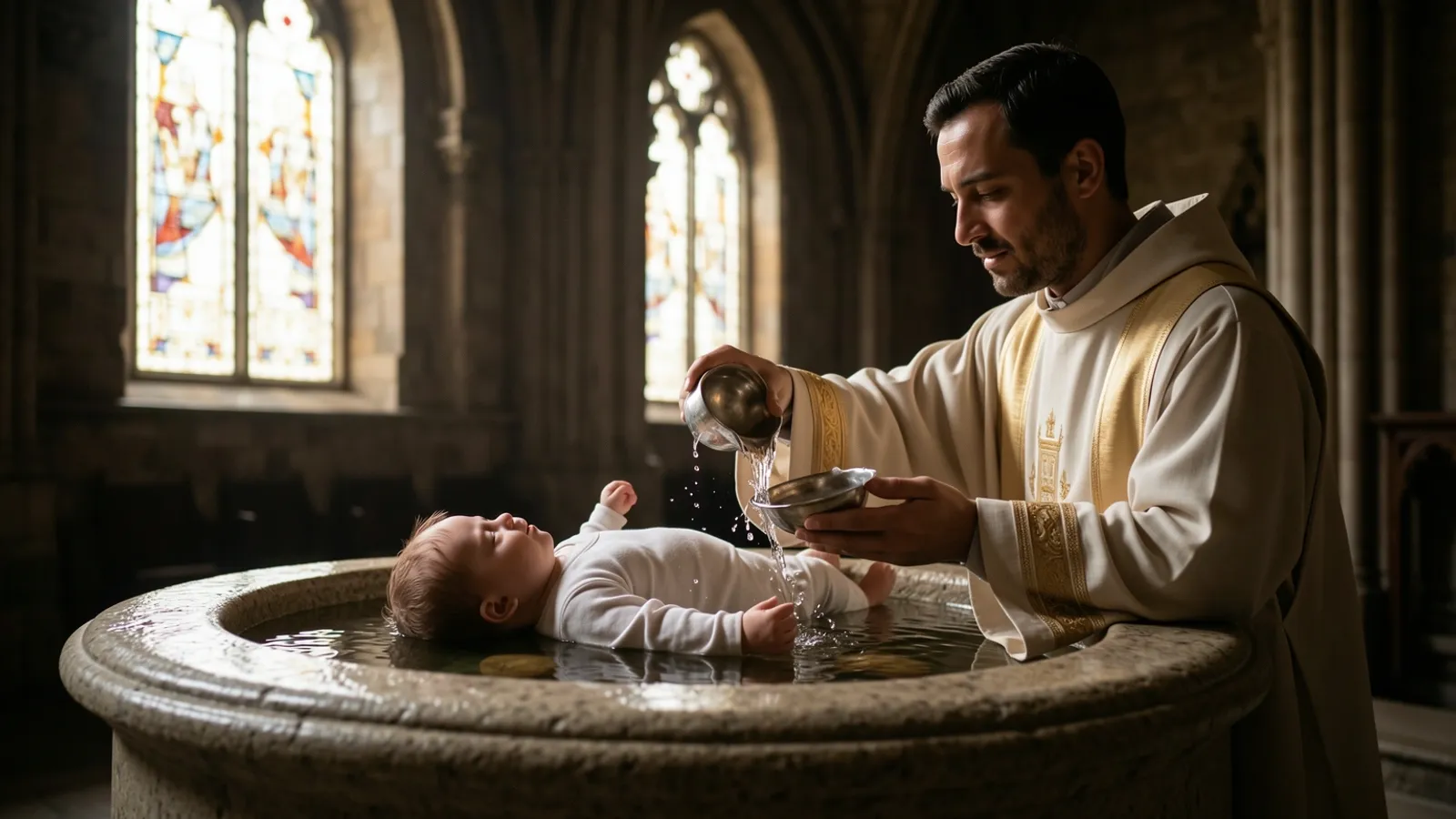
In the Catholic Church, the essential rite of the sacrament consists in plunging the candidate into water or pouring water over his head while pronouncing the invocation of the Most Holy Trinity: the Father, the Son, and the Holy Spirit. While the full liturgical celebration includes anointings, the clothing with a white garment, and the giving of a lighted candle, these are explanatory rites that manifest the effects of the sacrament. In an emergency, any person, even a non-baptized person, can baptize as long as they have the intention of doing what the Church does and use the correct matter and form. This provision highlights the supreme importance the Church places on the availability of Baptism for the salvation of souls.
Common Misconceptions About Baptism
There are several misconceptions regarding Baptism that often arise in dialogue with non-Catholics or those influenced by secularism. One of the most common is the idea that Baptism is "just a symbol" or an "outward sign of an inward grace" that has already happened. This view, often held by certain Protestant denominations, contradicts the clear words of Scripture where water is described as actually doing something, washing away sins (Acts 22:16) and saving us (1 Peter 3:21).
Another misconception is that Baptism is a work and therefore contrary to salvation by grace. Critics argue that if we must be baptized to be saved, we are trying to "earn" our way into heaven. However, the Church teaches that Baptism is a sacrament of faith, and faith itself is a gift of grace. Baptism is not a human work but a divine work. It is God who acts through the water. We do not save ourselves by being baptized; God saves us through the instrument He chose. As Saint Paul says, it is the "washing of regeneration" that God performs out of His own mercy.
Finally, some believe that if a person is baptized as an infant, it "doesn't count" because they didn't choose it. This ignores the reality of prevenient grace, the grace that God gives us before we can even seek Him. Just as parents provide physical life, food, and education for their children before they can choose them, the Church, as a spiritual mother, provides the life of grace for her children. The child will eventually have to make the faith their own through a personal act of will, but the seed of that faith is planted in Baptism. Understanding the Scriptural basis for the Eucharist can also help one see how God continues to nourish that life of grace throughout a person's life.
The Effects of Baptism (Character and Grace)
Baptism produces several distinct effects in the soul of the recipient. The first is the infusion of sanctifying grace, which makes the soul pleasing to God and capable of living the supernatural life. Along with this grace, the soul receives the theological virtues of faith, hope, and charity, and the seven gifts of the Holy Spirit. These spiritual faculties enable the person to believe in God, to hope in His promises, and to love Him above all things. This is why the baptized are called "a new creation."
Another permanent effect is the sacramental character. This is an indelible spiritual mark that can never be erased, even by mortal sin or apostasy. It marks the person as belonging to Christ forever. This is why Baptism can never be repeated. Once a person is baptized, they are a Christian in the eyes of God for all eternity. This character also gives the person a share in the priesthood of Christ, allowing them to participate in the Church's liturgy and to offer their lives as a spiritual sacrifice.
- Remission of Sins: Forgiveness of Original Sin and all personal sins.
- New Life: Adoption as a child of God and a member of the Church.
- Indelible Mark: A permanent spiritual sign of belonging to Christ.
- Theological Virtues: The infusion of Faith, Hope, and Charity.
- Gifts of the Spirit: The sevenfold gifts for spiritual growth.
Practical Application: Living Your Baptism
Understanding the biblical basis for Baptism should lead to a deeper commitment to living out the baptismal call. This involves a daily rejection of sin and a pursuit of holiness. For those seeking to grow in their faith, the Church provides different levels of engagement with this reality depending on their current spiritual state. If you are looking for a community to support you, you can use the Prayla feature to find a Catholic Church near me and participate in the life of a parish.
Beginner: Remembering the Foundation
For those just beginning to take their faith seriously, the first step is to learn the date of your Baptism and celebrate it annually like a second birthday. Make it a habit to use holy water when entering a church or before sleep, making the Sign of the Cross to remind yourself of the Trinitarian formula. Read the daily Mass readings to stay connected to the Word of God that was first planted in you at the font.
Intermediate: Renewing the Promises
A regular practitioner should focus on the renunciation of sin. Every year at the Easter Vigil, we renew our baptismal promises. You can do this more frequently by reflecting on the baptismal questions: Do you renounce Satan? And all his works? And all his empty promises? Pair this with a regular examination of conscience and the Sacrament of Confession to keep the baptismal garment white and unstained by mortal sin.
Advanced: The Apostolic Mission
Those who are ready for a greater commitment should see their Baptism as a call to apostolate. Since you are incorporated into the Body of Christ, you share in His mission to save souls. This can involve teaching the faith to others, sponsoring a catechumen in the RCIA process, or dedicating your professional and family life to the glory of God. Deepen this commitment through regular participation in the Liturgy of the Hours, which is the prayer of the baptized Body of Christ.
Prayer
Almighty and eternal God, who hast regenerated us by water and the Holy Spirit, and hast given us forgiveness of all our sins, continue to pour out Thy grace upon us. Grant that we may always remain in the number of Thy faithful children, and that we may never lose the dignity of our baptismal character. Help us to walk in newness of life, following the example of Thy Son, Jesus Christ, so that we may finally come to the eternal joys of Thy kingdom. Through the same Christ our Lord. Amen.
Further Reading
- Catechism of the Catholic Church, paragraphs 1213-1284.
- Council of Trent, Session VII, Canons on the Sacrament of Baptism.
- Pope Pius XII, Encyclical Mystici Corporis Christi (On the Mystical Body of Christ).
- Saint Thomas Aquinas, Summa Theologiae, Third Part, Questions 66-71.
- Roman Catechism (Catechism of the Council of Trent), Part II: The Sacraments, Baptism.