How to Pray the Divine Mercy Chaplet
The chaplet of divine mercy prayer is a powerful Catholic devotion recited on standard rosary beads that focuses on the mercy of God as revealed through the Passion of Jesus Christ. To pray it, one offers the Body, Blood, Soul, and Divinity of Christ to God the Father in atonement for the sins of the world. This chaplet is traditionally prayed at the three o'clock hour, the hour of Christ's death, and is central to the celebration of Divine Mercy Sunday during the Octave of Easter.
Who Was Saint Faustina Kowalska
Saint Faustina Kowalska was a Polish nun who lived in the early twentieth century and served as the messenger for the modern devotion to Divine Mercy. Born Helena Kowalska in 1905, she entered the Congregation of the Sisters of Our Lady of Mercy in Warsaw at the age of 20. Throughout her life in the convent, she experienced numerous mystical visions of Jesus Christ, which she recorded in a diary titled Divine Mercy in My Soul. This diary eventually reached over 600 pages in length and serves as the primary source for the prayers and promises associated with the chaplet.
Faustina lived a life of profound humility and hidden suffering, working mostly in the kitchen or the garden of her convents in Krakow, Plock, and Vilna. Despite her lack of formal education, her writings display a deep theological understanding of God's attributes, specifically His infinite mercy. On September 13, 1935, Faustina received the specific instructions for the Chaplet of Divine Mercy while in her cell in Vilna. She saw an angel sent to punish a city and felt powerless to stop it until she heard the words of the chaplet interiorly. As she prayed them, the angel became helpless and could not carry out the punishment.
Saint Faustina died of tuberculosis at the young age of 33 on October 5, 1938. Her cause for sainthood was championed by her fellow countryman, Pope John Paul II, who eventually canonized her on April 30, 2000, making her the first saint of the new millennium. Her life reminds the faithful that God often chooses the most obscure and simple souls to carry out His most significant work in the Church. Today, millions of Catholics across the globe look to her as the "Apostle of Mercy" and follow the path of trust she laid out in her writings.
The Theological Foundation of Divine Mercy
The theology of Divine Mercy is rooted in the biblical understanding that God's mercy is His greatest attribute in relation to His creatures. The Catechism of the Catholic Church teaches that the Gospel is the revelation in Jesus Christ of God's mercy to sinners (CCC 1846). This mercy is not a sentiment but a concrete action of God to rescue humanity from the state of original sin and personal transgression. The Council of Trent, in its Sixth Session on justification, emphasized that while God is a just judge, His mercy is always available to those who approach Him with a contrite heart.
In the chaplet, the phrase "offer You the Body and Blood, Soul and Divinity" mirrors the language used by the Church to describe the Real Presence of Christ in the Eucharist. When Catholics learn what the Bible says about the Eucharist, they discover that the sacrifice of the Cross and the sacrifice of the Altar are one and the same. By praying the chaplet, the faithful exercise their baptismal priesthood by offering the sacrifice of Christ to the Father, a concept explored in depth by Saint Thomas Aquinas in the Summa Theologiae (ST III, q.22). This act of offering is propitiatory, meaning it seeks to appease the justice of God by appealing to the infinite merits of Christ's Passion.
Mercy does not contradict justice; rather, it fulfills it. As Saint Augustine noted, God created us without us, but He will not save us without us. The chaplet is a tool for cooperation with grace. It acknowledges that human effort is insufficient to atone for the weight of mortal sin, and therefore we must rely entirely on the merit of the Savior. This total reliance on God is what the Church calls the virtue of hope, which keeps us from both presumption and despair. By focusing on the "sorrowful passion," we align our hearts with the suffering of the God-man who took upon Himself the iniquity of us all.
How to Pray the Divine Mercy Chaplet Step by Step
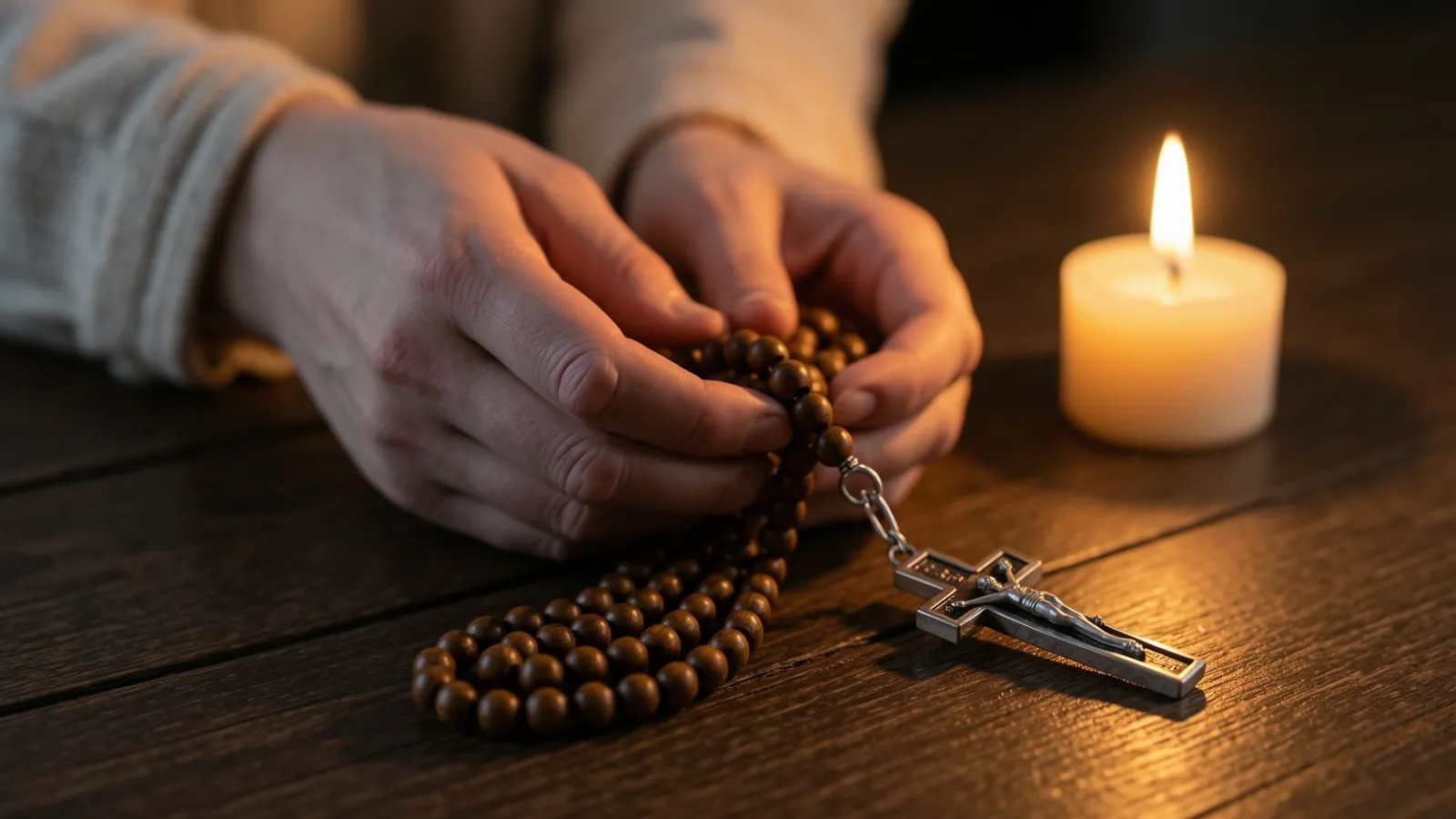
Praying the chaplet is simple and requires only a standard set of rosary beads, consisting of 59 beads in total. The devotion begins with the Sign of the Cross and may include optional opening prayers. After the initial prayers, the practitioner moves to the three beads that usually precede the decades of the Rosary. On these beads, one recites the Our Father, the Hail Mary, and the Apostles' Creed. These three foundational prayers root the devotion in the essential tenets of the Christian faith and the prayer given to us by Christ Himself.
Once the introductory prayers are finished, the chaplet follows the structure of five decades. On the large bead that normally starts a decade of the Rosary, the "Eternal Father" prayer is said. On each of the ten small beads within the decade, the "For the sake of His sorrowful Passion" response is repeated. This rhythmic repetition is intended to facilitate a meditative state, allowing the soul to dwell on the various aspects of Christ's suffering, from the Agony in the Garden to the Piercing of His Side. Many people find it helpful to use Prayla's chaplets feature to keep track of the prayers while focusing on the meditation.
To conclude the chaplet, the practitioner recites the Trisagion, which is the "Holy God" prayer, three times. This is often followed by a closing prayer and the Sign of the Cross. The entire devotion typically takes about 10 to 15 minutes, making it an accessible practice for those with busy schedules. Despite its brevity, the Church teaches that the efficacy of prayer depends more on the fervor and trust of the person praying than on the length of the words used. Below is a table summarizing the sequence of the chaplet.
| Order | Prayer Component | Location on Rosary |
|---|---|---|
| 1 | Sign of the Cross | Crucifix |
| 2 | Optional Opening Prayers | Crucifix |
| 3 | Our Father | First Large Bead |
| 4 | Hail Mary | First Small Bead |
| 5 | Apostles' Creed | Second Small Bead |
| 6 | Eternal Father Prayer | Large Beads (Decade Starters) |
| 7 | Sorrowful Passion Prayer | Small Beads (10 per Decade) |
| 8 | Holy God (Trisagion) | Final Three Recitations |
| 9 | Optional Closing Prayer | End of Beads |
The Opening Prayers and Their Significance
The choice of the Our Father, Hail Mary, and Apostles' Creed as the opening for the chaplet is not accidental. The Our Father is the "summary of the whole Gospel" (CCC 2761) and establishes our relationship with God as children of a merciful Father. The Hail Mary seeks the intercession of the Mother of Mercy, who stood at the foot of the Cross and participated in the suffering of her Son in a unique way. Those who know how to pray the Rosary will recognize these as the pillars of Marian devotion, but here they serve to prepare the soul for the specific petitions of the chaplet.
The Apostles' Creed is particularly vital because it summarizes the 12 articles of faith handed down from the Apostles. By reciting the Creed, the person praying the chaplet makes a formal profession of faith in the Trinity, the Incarnation, and the Resurrection. Mercy cannot be properly understood apart from the dogmas of the Church. For instance, the belief in the "forgiveness of sins" mentioned in the Creed is the very foundation upon which the chaplet is built. Without a belief in the reality of sin and the possibility of forgiveness, the chaplet would be a meaningless exercise.
In the traditional practice, many also add the prayer: "You expired, Jesus, but the source of life gushed forth for souls, and the ocean of mercy opened up for the whole world." This optional opening prayer, taken directly from Saint Faustina's diary, highlights the moment of Christ's death as a generative act. It suggests that the death of Christ was not an end, but the opening of a spiritual reservoir from which all grace flows. This imagery of an "ocean" or a "fountain" is common in the writings of the Doctors of the Church, such as Saint Catherine of Siena, who spoke of the blood of Christ as a fire that cleanses the soul.
Understanding the Eternal Father Prayer
The heart of each decade in the chaplet is the "Eternal Father" prayer. The text is as follows: "Eternal Father, I offer You the Body and Blood, Soul and Divinity of Your Dearly Beloved Son, Our Lord Jesus Christ, in atonement for our sins and those of the whole world." This prayer is a form of spiritual sacrifice. It echoes the liturgy of the Mass, where the priest offers the victim to the Father. While the laity do not possess the ministerial priesthood to consecrate the Eucharist, all the baptized share in the universal priesthood of Christ, allowing them to offer their lives and prayers in union with the Holy Sacrifice.
Offering the "Soul and Divinity" of Christ is a profound theological statement. It acknowledges that Jesus is one Person with two natures: human and divine. This is the dogma of the Hypostatic Union, defined at the Council of Chalcedon in 451 AD. By offering His divinity, we are offering something of infinite value to the Father. Because Christ is God, His suffering has infinite merit, which is sufficient to satisfy the debt of all human sin, no matter how grave. This is the source of our confidence when we ask what the Bible says about Confession, as we know the merit of Christ is applied to us through the sacraments.
The phrase "in atonement for our sins and those of the whole world" demonstrates the communal nature of Catholic prayer. We do not pray for ourselves alone. The Church is the Mystical Body of Christ, and the actions of one member affect the whole. This is the principle of the Communion of Saints. When we pray the chaplet, we are acting as intercessors for those who cannot or will not pray for themselves. We pray for the dying, for those in mortal sin, and for the souls in Purgatory, asking that the mercy of God reach every corner of creation.
Meditating on the Sorrowful Passion
The response repeated ten times in each decade is: "For the sake of His sorrowful Passion, have mercy on us and on the whole world." This prayer is intended to keep the mind focused on the reality of the Crucifixion. The word "passion" comes from the Latin passio, meaning suffering. To meditate on the Passion is to look at the physical and spiritual agony Jesus endured from the Garden of Gethsemane to the hill of Golgotha. This includes the scourging at the pillar, the crowning with thorns, and the carrying of the cross.
The Scourging and Crowning
The physical torments of Christ were extreme. Roman scourging involved the use of a flagrum, a whip with multiple thongs tipped with lead or bone, designed to tear the flesh. This suffering was offered for our sins of the flesh and our lack of temperance. The crowning with thorns was a mockery of Christ's kingship, representing the sins of pride and intellectual arrogance. When we say "For the sake of His sorrowful Passion," we are bringing these specific images to mind and asking that the blood shed during these moments wash away our specific venial and mortal sins.
The Piercing of the Side
Perhaps the most significant moment of the Passion for the Divine Mercy devotion is the piercing of Jesus' side by the lance of Longinus. Saint John's Gospel records that "immediately there came out blood and water" (John 19:34). The Church Fathers, such as Saint John Chrysostom, taught that this blood and water represent the two primary sacraments of the Church: the Eucharist and Baptism. This moment is captured in the Divine Mercy image, where the red and pale rays emanate from the Heart of Jesus. Meditating on this helps us realize that mercy is not just a feeling, but a sacramental reality.
The Three O'Clock Hour of Mercy
Jesus specifically asked Saint Faustina that the chaplet be prayed, or at least the stations of the cross be meditated upon, during the three o'clock hour. He called this the "hour of great mercy for the whole world." According to the Synoptic Gospels, it was at the ninth hour (three in the afternoon) that Jesus cried out and gave up His spirit (Matthew 27:46-50). This is the moment when the victory over sin and death was won. By pausing at this time, Catholics acknowledge that every grace they receive was purchased by the death of the Savior.
At three o'clock, implore My mercy, especially for sinners; and, if only for a brief moment, immerse yourself in My Passion, particularly in My abandonment at the moment of agony. This is the hour of great mercy for the whole world. [Diary of St. Faustina, 1320]
In a practical sense, the three o'clock hour serves as a daily reminder to live in a state of recollection. In a world that is often fast-paced and secular, taking a moment to acknowledge the Passion of Christ re-centers the soul on its eternal destiny. If someone cannot pray the full chaplet at three o'clock, they can still offer a brief aspiration, such as "Jesus, mercy!" or "O Blood and Water, which gushed forth from the Heart of Jesus as a fount of mercy for us, I trust in You!" This practice helps fulfill the biblical command to "pray without ceasing" (1 Thessalonians 5:17).
Many Catholics set alarms on their phones or use the Prayla liturgical calendar to keep track of this hour. It is a time when the heavens are said to be wide open to petitions. Faustina wrote that Jesus promised He would refuse nothing to the soul that makes a request in the name of His Passion at this hour, provided the request is compatible with God's will. This is not a magic formula, but a testament to the power of Christ's sacrifice and His desire to pour out grace upon those who ask.
The Conclusion and the Holy God Prayer
The chaplet concludes with the triple recitation of the Trisagion: "Holy God, Holy Mighty One, Holy Immortal One, have mercy on us and on the whole world." This prayer has ancient roots in the Eastern Liturgy and is also found in the Roman Rite during the Good Friday liturgy, known as the Improperia or Reproaches. It is an address to the Holy Trinity, acknowledging God's holiness, His power, and His eternal nature. By repeating it three times, we echo the song of the Seraphim in the vision of Isaiah (Isaiah 6:3).
The Trisagion serves as a powerful seal on the chaplet. After having offered the sacrifice of the Son to the Father, we stand in awe of the Triune God. The title "Holy Mighty One" reminds us that God has the power to overcome any evil, while "Holy Immortal One" reminds us that He is the source of eternal life. In times of plague, war, or personal distress, this prayer has historically been used by the Church as a cry for protection. It reminds us that our only true security lies in the holiness and power of God.
Following the Trisagion, many people add the closing prayer: "Eternal God, in whom mercy is endless and the treasury of compassion inexhaustible, look kindly upon us and increase Your mercy in us, that in difficult moments we might not despair nor become despondent, but with great confidence submit ourselves to Your holy will, which is Love and Mercy itself." This prayer addresses the common human experience of "difficult moments." It asks for the grace of perseverance, which is the ability to remain faithful to God even when feelings of devotion are absent or life is full of trial.
Divine Mercy Sunday and the Octave of Easter
Divine Mercy Sunday is celebrated on the Second Sunday of Easter, concluding the Octave of Easter. This feast was officially established for the entire Church by Pope John Paul II in the year 2000. The Octave of Easter is treated as one continuous day of celebration, and the feast of Divine Mercy is the culmination of this "Great Day." The choice of this day is deeply symbolic, as the Gospel reading for the day always concerns the institution of the Sacrament of Penance, where the risen Christ breathes on the Apostles and gives them the power to forgive sins (John 20:22-23).
To observe Divine Mercy Sunday properly, the faithful are encouraged to go to Confession, receive Holy Communion, and perform acts of mercy. There is a specific plenary indulgence attached to the devotions performed on this day. An indulgence is the remission before God of the temporal punishment due to sins whose guilt has already been forgiven (CCC 1471). To gain this indulgence, one must be in a state of grace, have a complete detachment from all sin (even venial), and fulfill the usual conditions of praying for the Pope's intentions and receiving the sacraments.
| Condition | Requirement for Plenary Indulgence |
|---|---|
| Sacramental Confession | Within about 20 days before or after the feast |
| Holy Communion | Received on the day of the feast |
| Prayer for the Pope | Usually an Our Father and a Hail Mary |
| Devotion | Recite the Divine Mercy Chaplet or other mercy prayers in a church |
| Disposition | Complete detachment from even venial sin |
This feast is a reminder that the Resurrection of Christ is the ultimate act of mercy. By rising from the dead, Jesus proved that His sacrifice was accepted by the Father and that death no longer has the final word. The Octave of Easter is a period of intense joy, and the Divine Mercy devotion directs that joy toward the practical reality of our own salvation. It is a day when the "floodgates of heaven" are opened, and the Church invites everyone, especially those who have been away from the faith, to return to the fountain of grace.
The Image of Divine Mercy
In 1931, Jesus appeared to Saint Faustina and instructed her to have an image painted according to the pattern she saw. The image depicts Jesus with His right hand raised in blessing and His left hand touching His garment at the breast. From the opening of His garment, two large rays emanate, one red and the other pale. At the bottom of the image are the words: "Jesus, I Trust in You." This image is not merely a piece of art but a visual summary of the entire Divine Mercy message.
Meaning of the Rays
When Faustina asked Jesus about the meaning of the rays, He explained that the red ray represents the Blood, which is the life of souls, and the pale ray represents the Water, which makes souls righteous. As mentioned previously, these point to the sacraments of the Eucharist and Baptism. They also represent the gift of the Holy Spirit, whose first work is the forgiveness of sins. The rays are spread out, signifying that the mercy of God is not meant for a select few but is offered to all humanity. They appear to be moving toward the viewer, suggesting that God is always taking the initiative to seek out the lost sheep.
The Importance of Trust
The signature of the image, "Jesus, I Trust in You," is the essential response of the human soul to God's mercy. Trust, in the biblical sense, is more than an emotion; it is an act of the will. It is the "amen" we give to God's promises. Saint Faustina wrote that trust is the vessel by which we draw grace from the fountain of mercy. If the vessel is small, we receive little; if it is large, we receive much. By placing this image in our homes and churches, we are making a public profession that we do not rely on our own strength or merits, but on the goodness of the Savior.
The Novena of Divine Mercy
While the chaplet can be prayed at any time, Jesus requested a specific novena of chaplets to begin on Good Friday and end on the Saturday before Divine Mercy Sunday. A novena is a nine-day period of prayer, modeled after the nine days the Apostles spent in the Upper Room waiting for the Holy Spirit. For each day of the Divine Mercy Novena, Jesus gave Faustina a different group of people to bring to His heart in prayer. This structure ensures that our intercession is comprehensive and reflects the universal salvific will of God.
- Day 1: All mankind, especially all sinners.
- Day 2: The souls of priests and religious.
- Day 3: All devout and faithful souls.
- Day 4: Those who do not believe in God and those who do not yet know Jesus.
- Day 5: The souls of those who have separated themselves from the Church.
- Day 6: The meek and humble souls and the souls of little children.
- Day 7: The souls who especially venerate and glorify Christ's mercy.
- Day 8: The souls in Purgatory.
- Day 9: Souls who have become lukewarm.
This novena is an excellent way to prepare for the feast of Divine Mercy. It forces the practitioner to look outside their own needs and consider the spiritual state of the world. For example, praying for "lukewarm souls" on the ninth day is a challenge to our own spiritual complacency. Lukewarmness, as described in the Book of Revelation (Revelation 3:16), is a state of indifference that is particularly offensive to God. By praying the chaplet for these intentions, we are asking that the fire of Christ's love reignite the hearts of those who have grown cold. You can use a novena calculator to ensure you start your prayers at the correct time to finish for the feast.
Common Misconceptions About the Chaplet
As with many popular devotions, there are several misconceptions regarding the Chaplet of Divine Mercy. One common misunderstanding is that this devotion is intended to replace the Holy Rosary. This is incorrect. The Rosary remains the preeminent Marian devotion of the Church and has been recommended by countless popes and saints. The Divine Mercy Chaplet is a distinct devotion with a different focus, primarily Christological and Eucharistic. Many faithful choose to pray both, perhaps the Rosary in the morning and the Chaplet at the three o'clock hour.
Another misconception is that the private revelations of Saint Faustina are "mandatory" for all Catholics to believe. The Church distinguishes between Public Revelation, which ended with the death of the last Apostle, and private revelation, which can help the faithful live out the Gospel in a particular historical period (CCC 67). While Catholics are not required by de fide dogma to believe in the specific visions of Saint Faustina, the Church has officially approved the devotion as being in perfect harmony with Sacred Scripture and Tradition. Once the Church approves a private revelation, it is considered "worthy of belief," and it would be imprudent to dismiss it lightly.
Some also worry that the focus on mercy downplays the reality of God's justice or the existence of Hell. However, a careful reading of Saint Faustina's diary reveals a very traditional view of the Four Last Things. She describes visions of Hell and Purgatory in vivid detail, noting that the greatest suffering in Hell is the loss of God. The message of mercy is precisely a warning and a remedy for the reality of judgment. Mercy is offered because there is a justice to be satisfied and a Hell to be avoided. Without the reality of sin and judgment, mercy would be unnecessary.
Practical Tiers for Prayer Commitment
Adopting a new prayer habit can be daunting, so it is helpful to approach the Divine Mercy Chaplet in stages. The goal is to move from a sporadic practice to a consistent interior life marked by trust in God. Whether you are a beginner or someone looking to deepen your existing devotion, there is always room for growth in the school of mercy.
Beginner Level
For those new to the chaplet, the first step is simply to learn the prayers and the structure. Start by praying the chaplet once a week, perhaps on Fridays in honor of the Passion. Use a guide or an app like Prayla to help you remember the words. At this stage, do not worry if your mind wanders; the act of setting aside ten minutes for God is a significant victory. Focus on the words of the "Eternal Father" prayer and try to understand what it means to offer Christ to the Father.
Intermediate Level
An intermediate practitioner might commit to praying the chaplet daily at the three o'clock hour. This requires more discipline and a conscious effort to pause during the workday. At this level, you should begin to integrate the meditations on the Passion. Instead of just saying the words, try to visualize one specific aspect of Christ's suffering during each decade. You might also start praying the annual novena leading up to Divine Mercy Sunday and make a regular habit of sacramental Confession to keep your soul ready for grace.
Advanced Level
Advanced devotion involves a total transformation of one's life according to the principles of mercy. This includes not only praying the chaplet but also performing spiritual and corporal works of mercy daily. An advanced practitioner lives in a constant state of trust, even during severe trials or spiritual dryness. They may also take up the practice of praying the chaplet for the dying, which Jesus specifically requested, promising that He would stand between the Father and the dying person not as a just Judge but as a merciful Savior. At this stage, the chaplet is no longer just a prayer you say, but a reflection of the way you live.
Biblical Basis for the Devotion
Although the specific form of the chaplet comes from a private revelation, the content is thoroughly biblical. The theme of God's mercy runs through the entire Old and New Testaments. The Psalms are filled with appeals to God's hesed, His steadfast, covenantal love. For example, Psalm 136 repeats the refrain "for his mercy endureth for ever" 26 times. The chaplet is a modern participation in this ancient liturgical tradition of praising God's mercy.
In the Gospels, Jesus constantly demonstrates mercy to the marginalized, the sick, and the sinful. His parables, such as the Prodigal Son (Luke 15:11-32) and the Good Samaritan (Luke 10:25-37), are foundational for understanding that God's mercy is active and seeking. The chaplet's focus on the Passion is the fulfillment of Christ's words: "Greater love hath no man than this, that a man lay down his life for his friends" (John 15:13). By praying the chaplet, we are standing at the foot of the Cross with Mary and John, witnessing the ultimate proof of that love.
The Epistle to the Ephesians tells us that "God, who is rich in mercy, for his great love wherewith he loved us, even when we were dead in sins, hath quickened us together with Christ" (Ephesians 2:4-5). This "richness" of mercy is what we tap into during the chaplet. We are not begging a reluctant God for a scrap of pity; we are approaching a Father who is "rich in mercy" and eager to pour it out. The chaplet is simply the way we open the door to that pre-existing ocean of love.
The Role of the Chaplet in Modern Life
In an age characterized by anxiety, division, and a loss of the sense of the sacred, the Divine Mercy Chaplet offers a path to interior peace. The world often operates on the principles of revenge and meritocracy, where one only gets what they deserve. The chaplet stands in stark contrast, proclaiming that we receive what we do not deserve because of the merits of another. This realization is the only true cure for the modern epidemic of perfectionism and the fear of failure.
Furthermore, the chaplet is a powerful tool for spiritual warfare. Saint Faustina recorded that the devil trembles at the mention of the Passion of Christ. In times of temptation or spiritual oppression, the rhythmic repetition of the chaplet can calm the soul and invoke the protection of the Precious Blood. It is a reminder that the battle has already been won on Calvary. By clinging to the chaplet, the faithful align themselves with the victory of Christ over the powers of darkness.
Ultimately, the goal of the chaplet is to prepare the soul for its final encounter with God. We pray "have mercy on us" not just for our current needs, but for the moment of our death. The Church has always taught the importance of a "happy death," which means dying in a state of grace, reconciled with God. The Divine Mercy devotion provides the spiritual tools to live and die with the confidence that we are falling into the arms of a merciful Father rather than a distant stranger. As we continue to read the Catholic Bible and participate in the life of the Church, the chaplet serves as a constant companion on the journey toward our eternal home.
Prayer
Eternal Father, I offer You the Body and Blood, Soul and Divinity of Your Dearly Beloved Son, Our Lord Jesus Christ, in atonement for our sins and those of the whole world. For the sake of His sorrowful Passion, have mercy on us and on the whole world. Holy God, Holy Mighty One, Holy Immortal One, have mercy on us and on the whole world. Amen.
Further Reading
- Diary: Divine Mercy in My Soul by Saint Maria Faustina Kowalska
- Dives in Misericordia (Rich in Mercy), Encyclical by Pope John Paul II (1980)
- Catechism of the Catholic Church, Paragraphs 1846–1876 (On Mercy and Sin)
- Misericordiae Vultus (The Face of Mercy), Bull of Indiction of the Extraordinary Jubilee of Mercy by Pope Francis (2015)
- The Roman Catechism (Catechism of the Council of Trent), Part I: The Creed, Article X